Back to the shelf

027

CapEx Decision Calculator

A five-step calculator for capital expenditure decisions, built so the answer is something you can defend.

Launched · Started February 2026 · Web App · Vibe-Coded

That's the whole thing.

The site's sound is off. The narration still plays.

This reading didn't load. The transcript is below.

Read the transcript

Capital expenditure decisions lock in large sums and long years at once. The evaluation process I watched was often informal and inconsistent. That bothered me. I built this in February twenty twenty-six, vibe-coded with AI, for a pharma company that needed a better way.

It walks you through five steps: cost, expected returns, timeline, strategic alignment, and whether to buy or outsource. Then it gives you return on investment, payback period, net present value, internal rate of return, and a composite score out of ten. It provides a colour-coded decision and a report that explains its reasoning.

The aim was a repeatable framework, an answer a decision-maker can reference and defend. It launched, and it runs on Vercel, no IT overhead. Take a look.

Narrated in my own cloned voice, generated with ElevenLabs v4.

Capital expenditure decisions lock in large sums and long commitments. The process behind those decisions was often informal and inconsistent. That bothered me.

I built this in February 2026, vibe-coded with AI, for a pharma company I work with. The goal was a tool the team could reach without going through IT. It runs as a Next.js web app on Vercel. No installation, no overhead.

The calculator walks you through five steps: cost, expected returns, timeline, strategic alignment, and whether to buy or outsource. From those inputs it produces net annual benefit, ROI, payback period, NPV and IRR. It also generates a composite score from 0 to 10, a colour-coded decision, and a report that explains its reasoning. It standardises how the company assesses capital spending.

The aim was a repeatable framework. An answer a decision-maker could reference and defend, not reconstruct from memory when challenged. It’s launched. There’s no public link.

The making

  • Next.js
  • React
  • Tailwind CSS
  • Vercel

01 · The problem

Before it existed

What hurt

Capital spending was judged informally. The same purchase could be argued three ways, and nobody could show the reasoning afterwards.

Who uses it

  • Plant managers
  • Department heads
  • Finance reviewers
  • Management
  • 19commits in seven weeks
  • 5steps in the form
  • 5weighted tests in one score
  • 4possible verdicts

02 · The flow

7 steps, in the order they happen

  1. 01 / 07

    Describe the asset

    You
    Names it, picks a category and a reason
    It answers
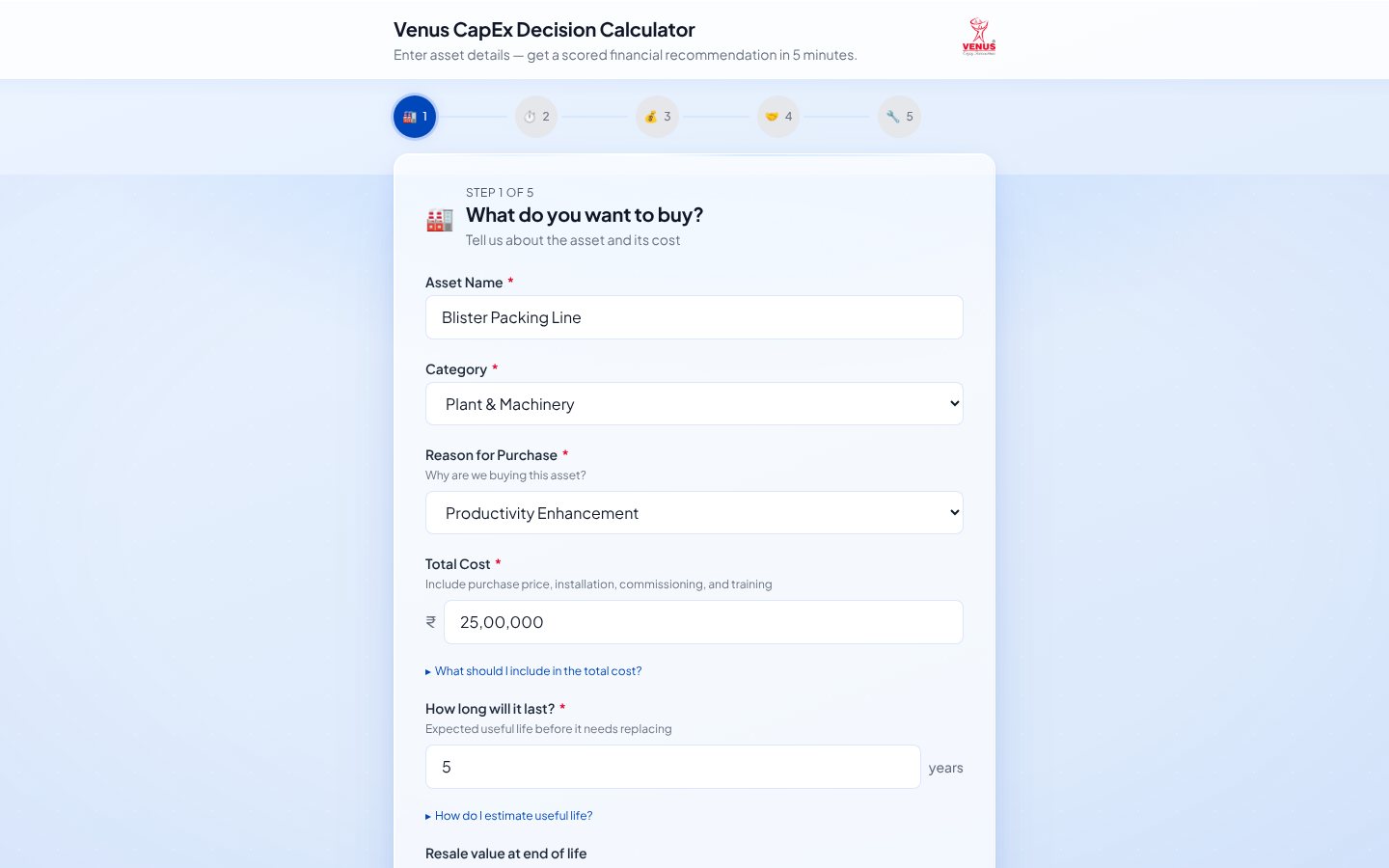
    Takes cost, useful life and resale value, with a short help note on each
    Step 1 of 5: asset name, category, reason for purchase, total cost and useful life
  2. 02 / 07

    Say how it will be used

    You
    Gives hours a day and days a week
    It answers
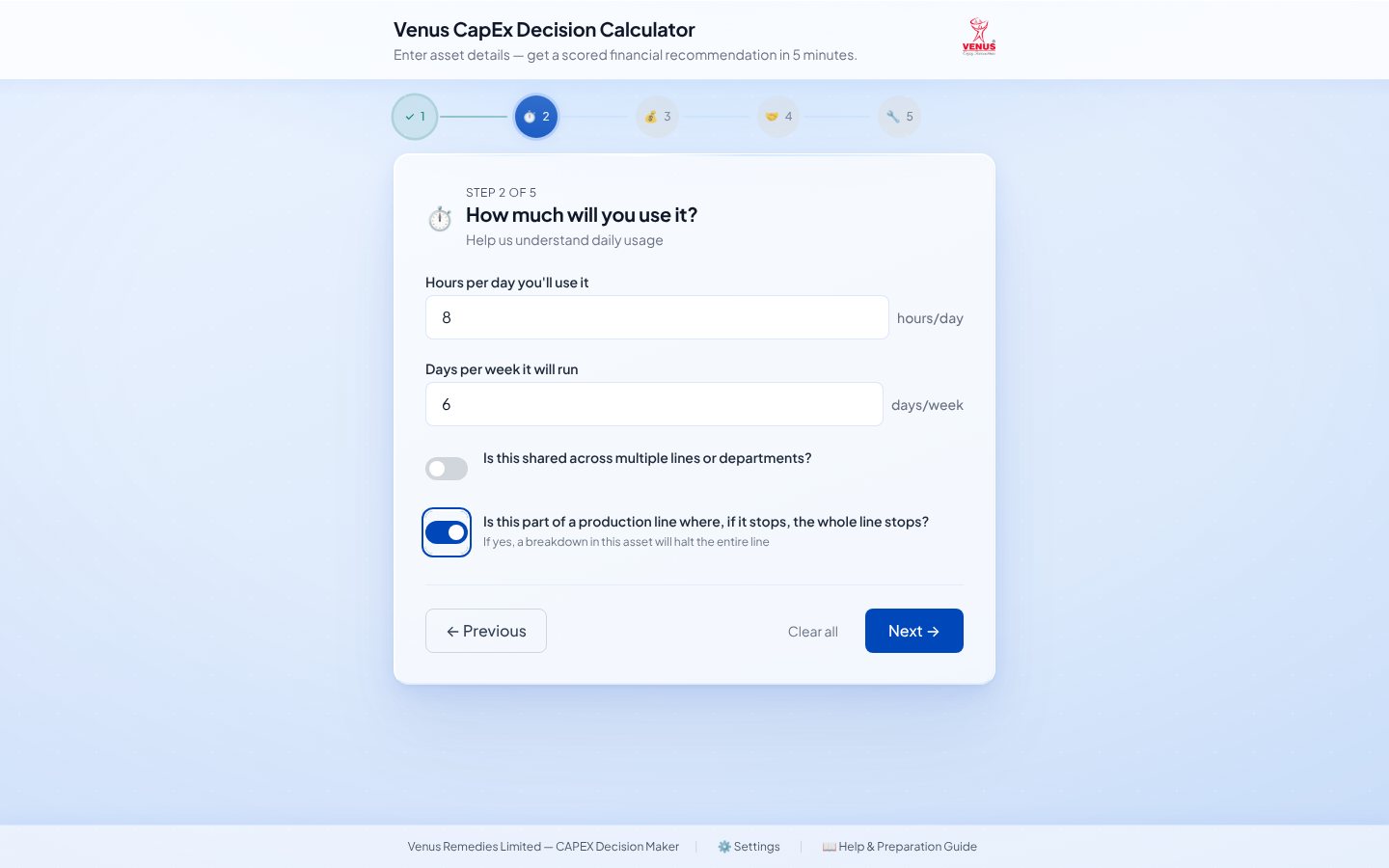
    Asks whether the use is shared and whether the line stops without it
    Step 2 of 5: hours per day, days per week and two switches
  3. 03 / 07

    Put a value on it

    You
    Enters revenue, savings and running cost
    It answers
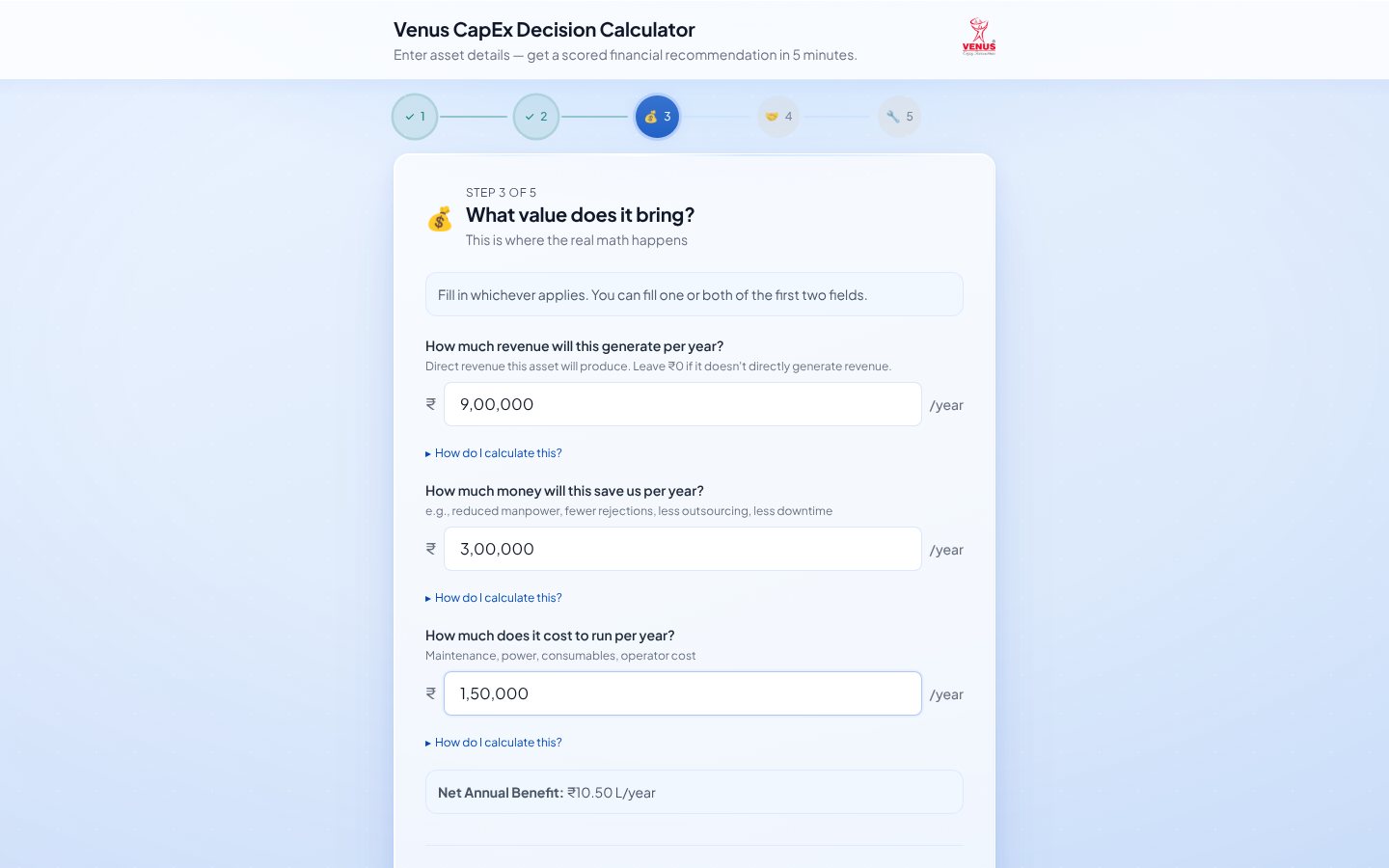
    Shows the net annual benefit as soon as the figures allow it
    Step 3 of 5: annual revenue, savings and running cost with the net benefit below
  4. 04 / 07

    Compare with outsourcing

    You
    Switches on the vendor option and its price
    It answers
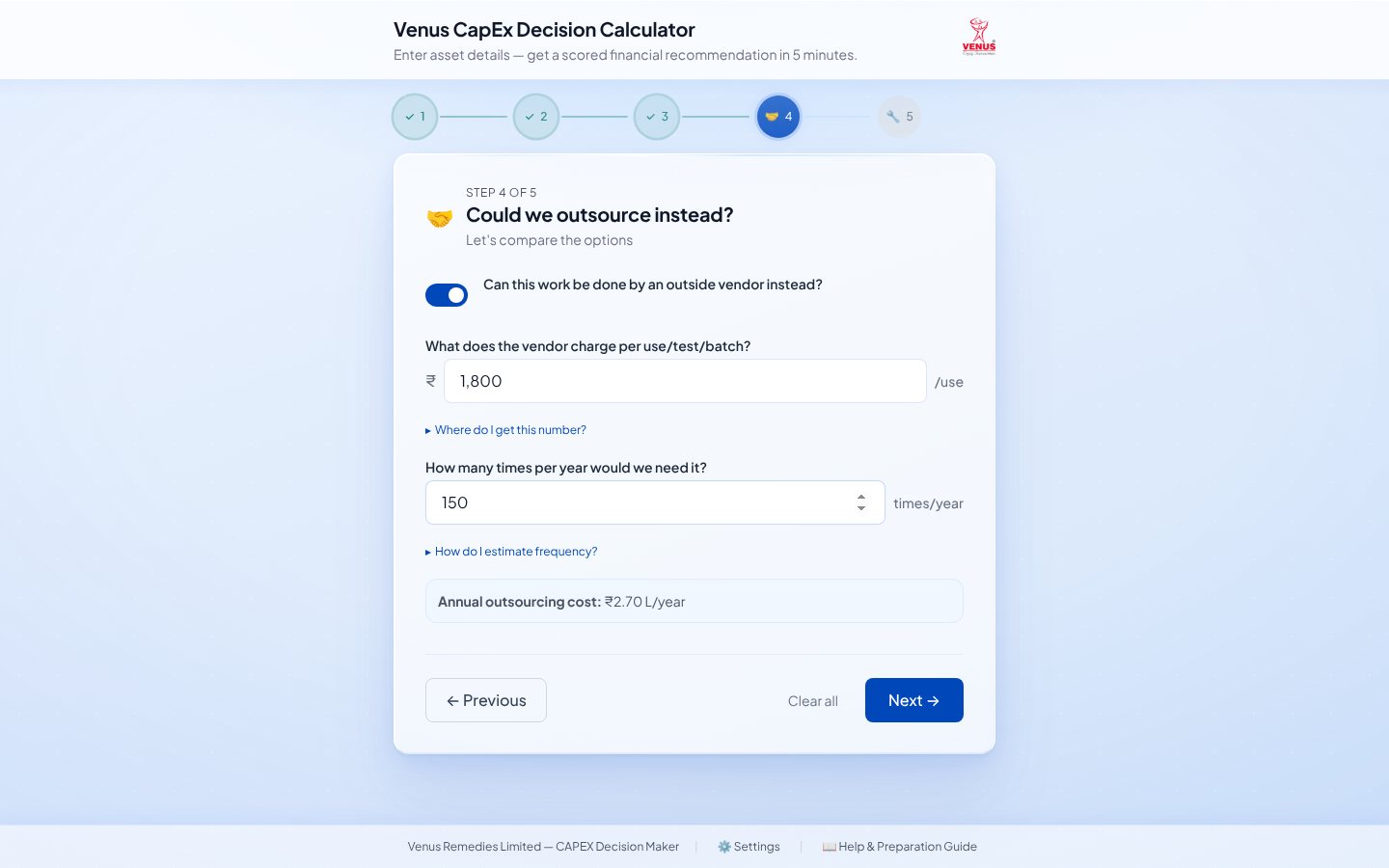
    Works out the yearly cost of paying someone instead of buying
    Step 4 of 5: vendor charge per use, uses per year and the annual outsourcing cost
  5. 05 / 07

    Add the old machine

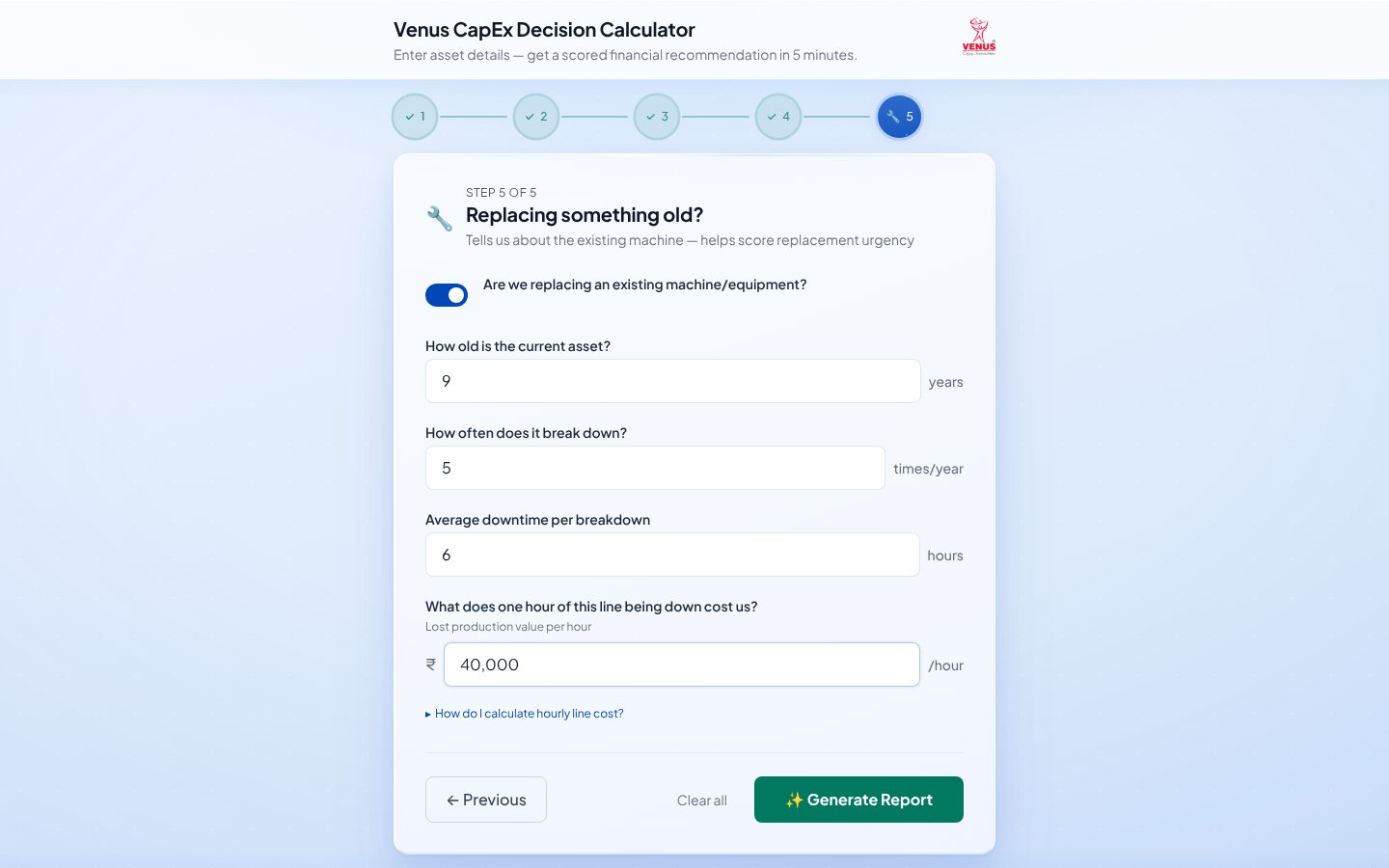
    You
    Gives its age, breakdowns and cost of downtime
    It answers
    Prices what keeping the old machine costs every year
    Step 5 of 5: age, breakdowns per year, downtime hours and hourly cost, with Generate Report
  6. 06 / 07

    Read the verdict

    You
    Generates the report
    It answers
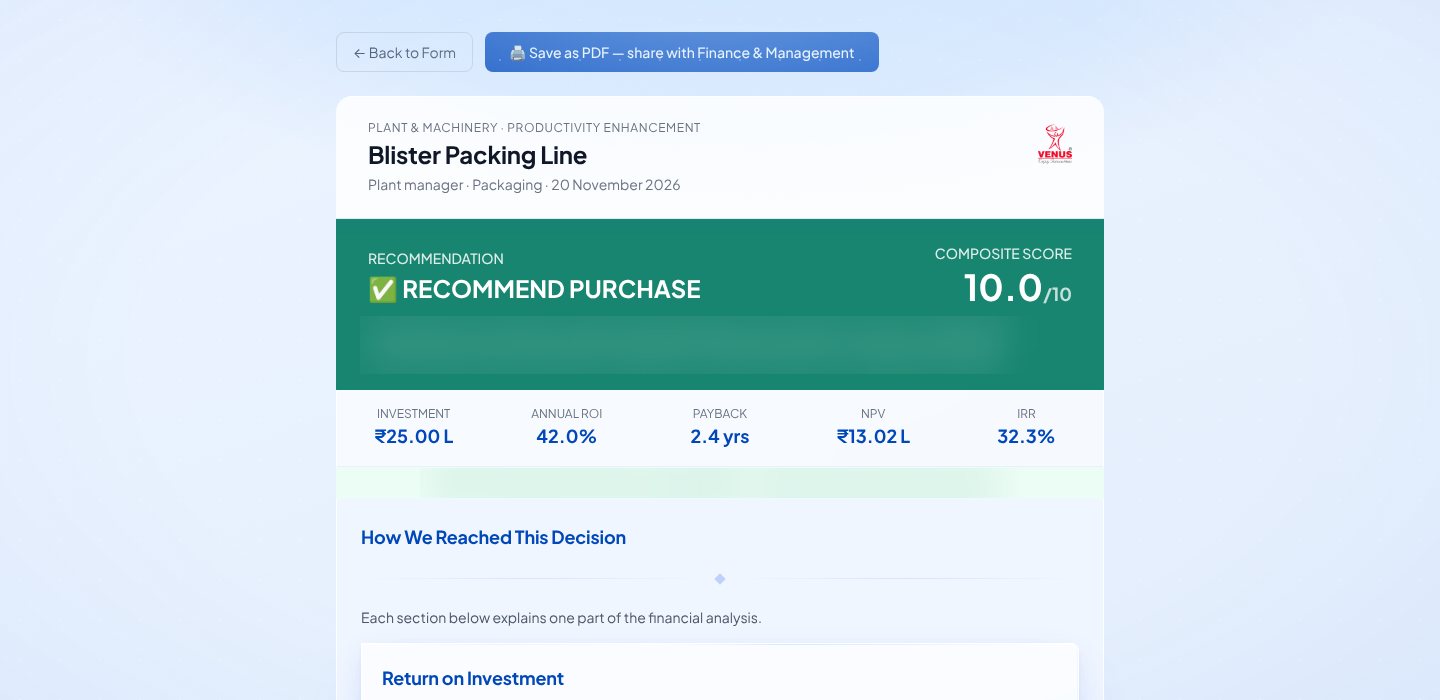
    Shows a colour-coded verdict, a score out of ten, ROI, payback, NPV and IRR
    Report header in green reading Recommend Purchase, score 10 out of 10, with five metrics
  7. 07 / 07

    Check the reasoning

    You
    Reads each test, or saves the report as a PDF
    It answers
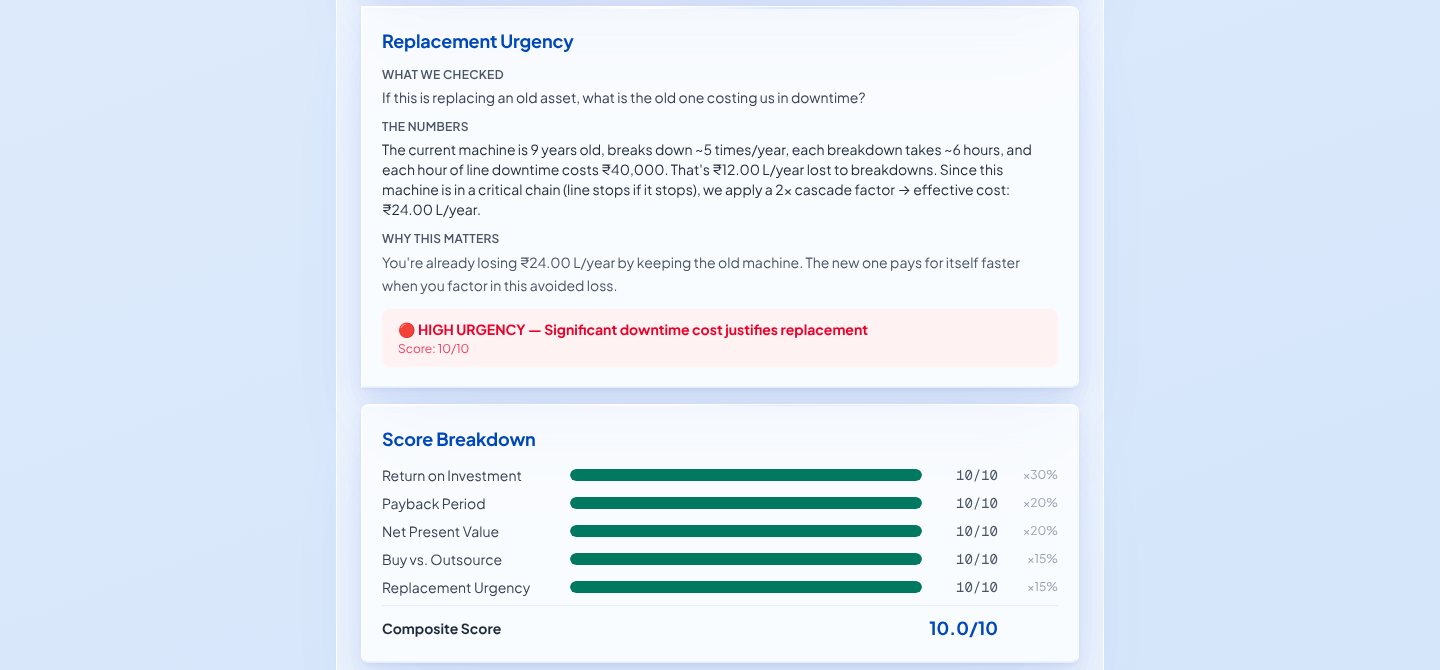
    Explains what was checked and why it matters, then lists the weighted score breakdown
    Replacement urgency test and the score breakdown across five weighted tests

03 · What was special

What it stands on

  1. A teacher in the report

    Each test names what was checked, shows the numbers, and explains why it matters – in plain words.

  2. Five tests, one score

    Return, payback, NPV, buy against outsource and urgency are weighted into one score and a colour.

  3. Help where people stall

    Fields ask in plain words, and a short note under each explains how to find the figure people usually lack.

The answer comes with its reasoning, ready to defend.

Making-Of

A large purchase should leave behind its reasons, not just its price.

The first commit and the Notion build hub, the same day

  1. The world before

    Capital expenditure locks in large sums for years, yet the way proposals were judged was informal and uneven. There was no common method and no record of why a purchase was approved.

  2. One day

    28 February 2026. A first draft of a guided calculator: five steps in, a scored recommendation out.

  3. Because of that

    1. Version 2 added the logo, an intro modal, asset categories, print output and NPV and IRR, then was updated after a leadership review (4 March).
    2. Version 3 added injectable-pharma examples and a PDF manual; IRR was reworked to a bisection on the NPV function so the two figures always agree (5 March).
    3. The look moved to a warm room-like atmosphere, then to a glass redesign (29 and 30 March, 16 April).
    4. A clarity audit and interaction pass followed, and the PDF report headers were fixed so the logo prints inline (16 April).
  4. Until finally

    The calculator is launched on Vercel. It has no public link, so it is reached by the people who use it.

  5. Since then

    The repository keeps the product plan, a user manual and learning notes on NPV and IRR alongside the app.

The evidence Process, hands, and artifacts

Process

  1. Origin

    A guided five-step form with a scored, colour-coded verdict

  2. Version 2

    Intro modal, categories, print output, NPV and IRR

  3. Review

    Updated after a leadership review

  4. Version 3

    Pharma examples, PDF manual, IRR by bisection

  5. Atmosphere

    A warm, room-like look in place of a plain form

  6. Glass

    Glass redesign, clarity audit, print headers fixed

Hands

Akshansh

  • The problem and the scoring model
  • The leadership review and what changed after it
  • Design direction at each pass

Agents

  • Claude CodeBuilt the app and its documentation
  • AmpCo-authored one change