043
Cleanroom Tracker
A 2D digital twin of each cleanroom: rounds planned and closed from outside, every step audit-ready.
This reading didn't load. The transcript is below.
Read the transcript


A cleanroom has rules. You cannot carry a device inside. Someone still has to plan the monitoring round and close it out. Every step has to stand up under audit. That problem was the start.
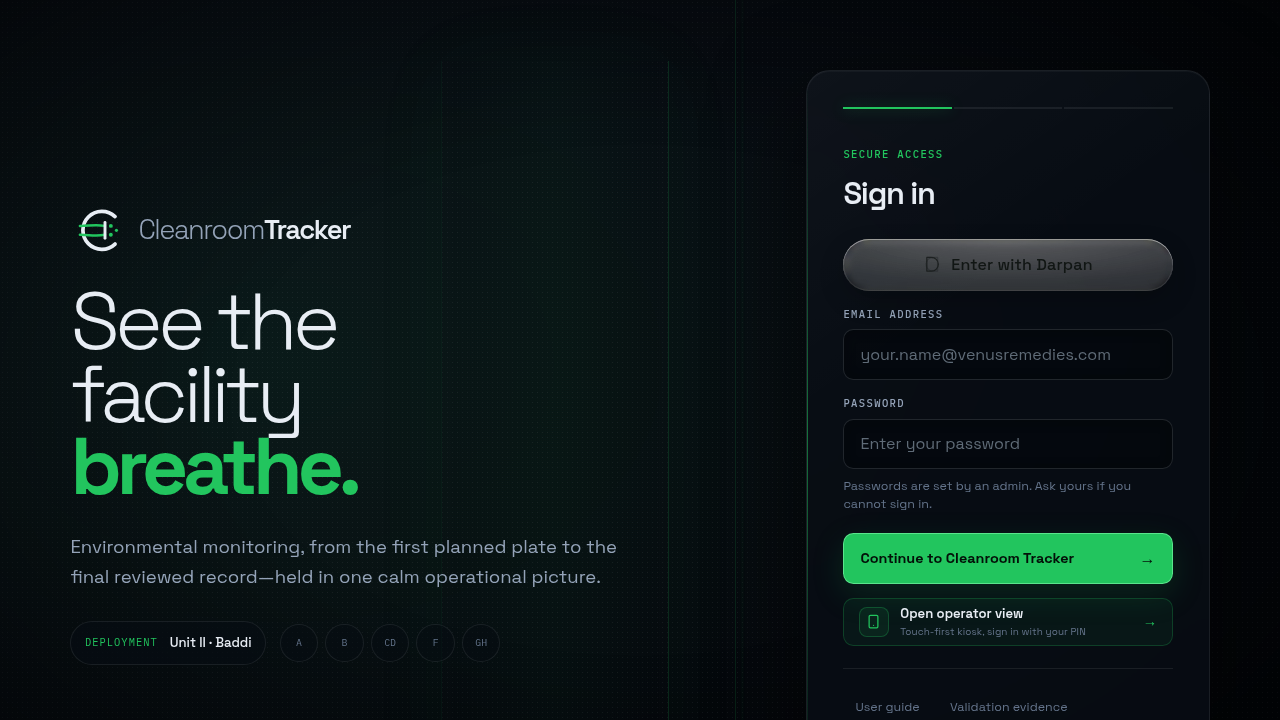
Cleanroom Tracker draws each room as a two-dimensional digital twin. Grade zones and monitoring points sit at true geometry, bound to live data. Operators plan and close plate-exposure rounds from outside, on a touch-first kiosk. Every change of state is logged. Reports print clean.
I vibe-coded it with AI in June twenty twenty-six, documentation first. It launched in July, live and in use, and has since scaled beyond the first facility. If this interests you, take a look.
Narrated in my own cloned voice, generated with ElevenLabs v4.
You cannot carry a device into a cleanroom. That one constraint is where this started.
I built Cleanroom Tracker for a pharma company’s environmental monitoring team, vibe-coded with AI starting June 2026. The problem was specific: monitoring rounds have to be planned, executed and closed without bringing a device inside the room. Every step, every decision, has to hold up under audit.
The answer was a two-dimensional digital twin. Each cleanroom is drawn to true geometry: rooms, grade zones and monitoring points, all bound to live data. From a touch-first kiosk outside the door, an operator plans a plate-exposure round with near-zero taps, then watches a countdown that cues exactly when to retrieve. The round moves through incubation reads and into QA review. The twin shows current status at a glance.
Every state change is logged. E-signatures are built in. Guardrails check operator qualification and media expiry before anything moves forward. Three printable PDF reports come out the other end.
I wrote the documentation first and the code second. That order shaped everything.
It launched in July 2026, live and in use. Since then it has scaled beyond the first facility through a per-facility pipeline.
The making
- Next.js
- React
- TypeScript
- PostgreSQL
- Prisma
- Tailwind CSS
- Zustand
- Vitest