Back to the shelf

032

Department Mission 2030

A living workbook that helps each department translate a 2030 company mission into measurable, annual work.

Launched · Started March 2026 · Web App · Vibe-Coded

That's the whole thing.

The site's sound is off. The narration still plays.

This reading didn't load. The transcript is below.

Read the transcript

A company-wide mission for twenty thirty only works if every department knows what it means for them. Then they have to act. That gap was where I started.

I built this in March twenty twenty-six for a pharma company, vibe-coded with AI. A living workbook. Each department breaks the mission into yearly objectives, key results, milestones, metrics and action items. They update it over time. When review comes around, it generates polished, print-ready reports. A tutorial video helps people get started.

It launched, and I built a sibling app later for daily progress. A mission can be alive, not a slide deck. This is what it looks like. Take a look.

Narrated in my own cloned voice, generated with ElevenLabs v4.

A company-wide mission for 2030 is easy to hang on a wall. It’s much harder to make it mean something on a Tuesday afternoon, inside a specific team, doing specific work.

Department Mission 2030 starts from that gap. It’s a living workbook for every department in the company, built to help each team break the 2030 mission into something they can act on: yearly objectives, key results, milestones, metrics and action items. Departments return to it and update it as the year moves. It’s a plan that breathes, not a slide deck.

When management needs a review, the tool generates a polished, print-ready report. No reformatting, no copy-pasting. The data that lives in the workbook becomes the document.

An onboarding tutorial video walks each team through the process from the start, so you don’t need a guide in the room.

I built this in March 2026, vibe-coded with AI, in HTML, JavaScript and Node.js. It launched. There’s no public link: it lives inside the company.

A sibling app followed later: a daily progress report tool for the same organisation, built to close the loop between the plan and the day.

The making

  • React
  • TypeScript
  • Vite

01 · The problem

Before it existed

What hurt

A company-wide mission is easy to approve and hard to act on. Each department needed its own yearly plan, in one format management could review.

Who uses it

  • Department leads
  • Department staff
  • Management reviewers
  • 85departments covered
  • 5mission slots per workbook
  • 18commits in three weeks
  • 5financial years, FY 26-27 to 30-31

02 · The flow

6 steps, in the order they happen

  1. 01 / 06

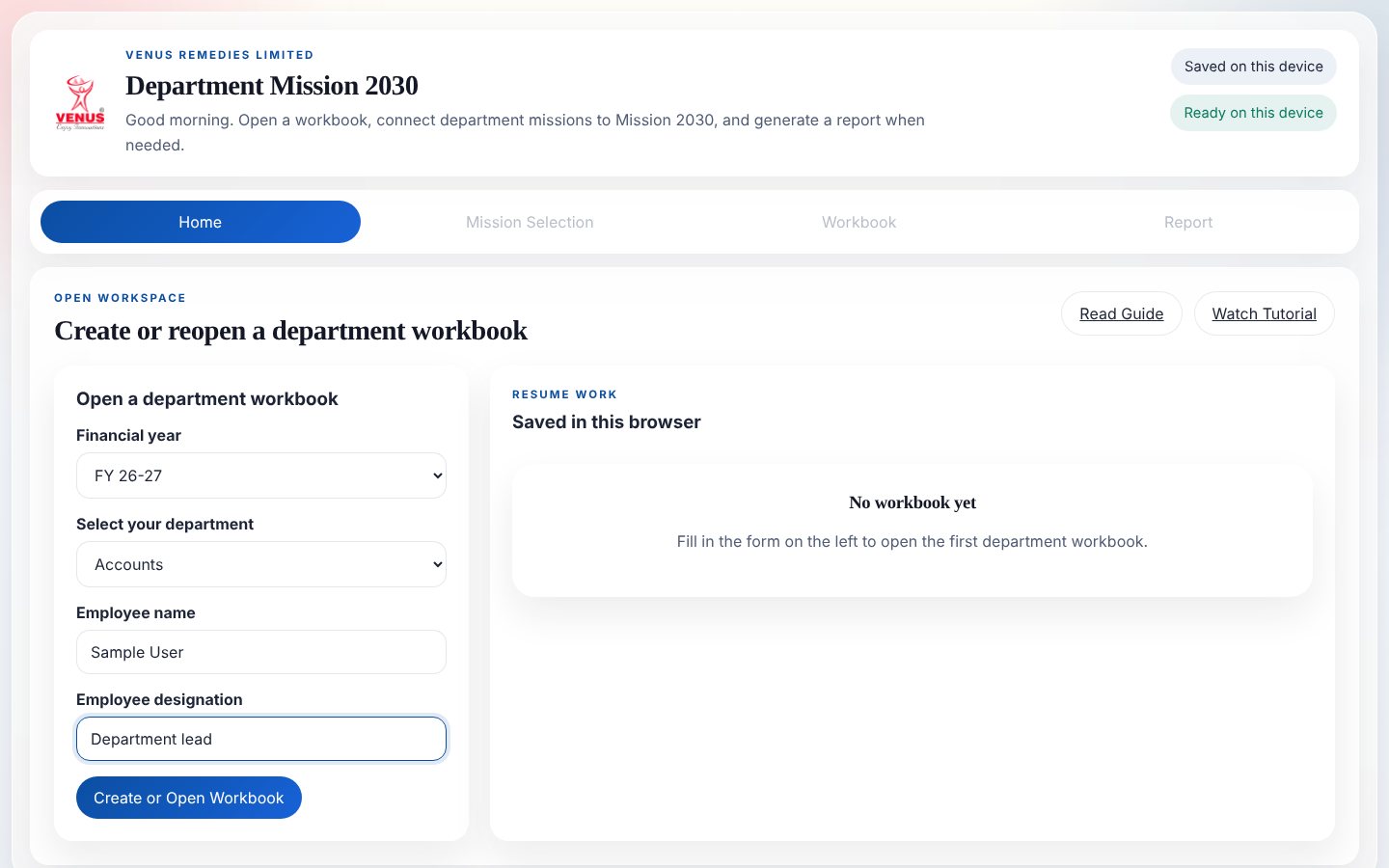
    Pick year and department

    You
    Chooses a financial year and a department, adds name and title
    It answers
    Opens or reopens that department’s workbook, saved in the browser
    The workbook form with a financial year, a department, a name and a title filled in
  2. 02 / 06

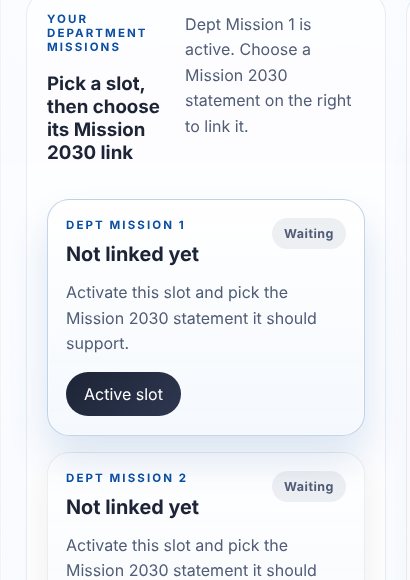
    Assign mission slots

    You
    Activates a slot and picks a Mission 2030 statement
    It answers
    Links it; one statement can serve several slots
    The slot column listing five department missions, the first active
  3. 03 / 06

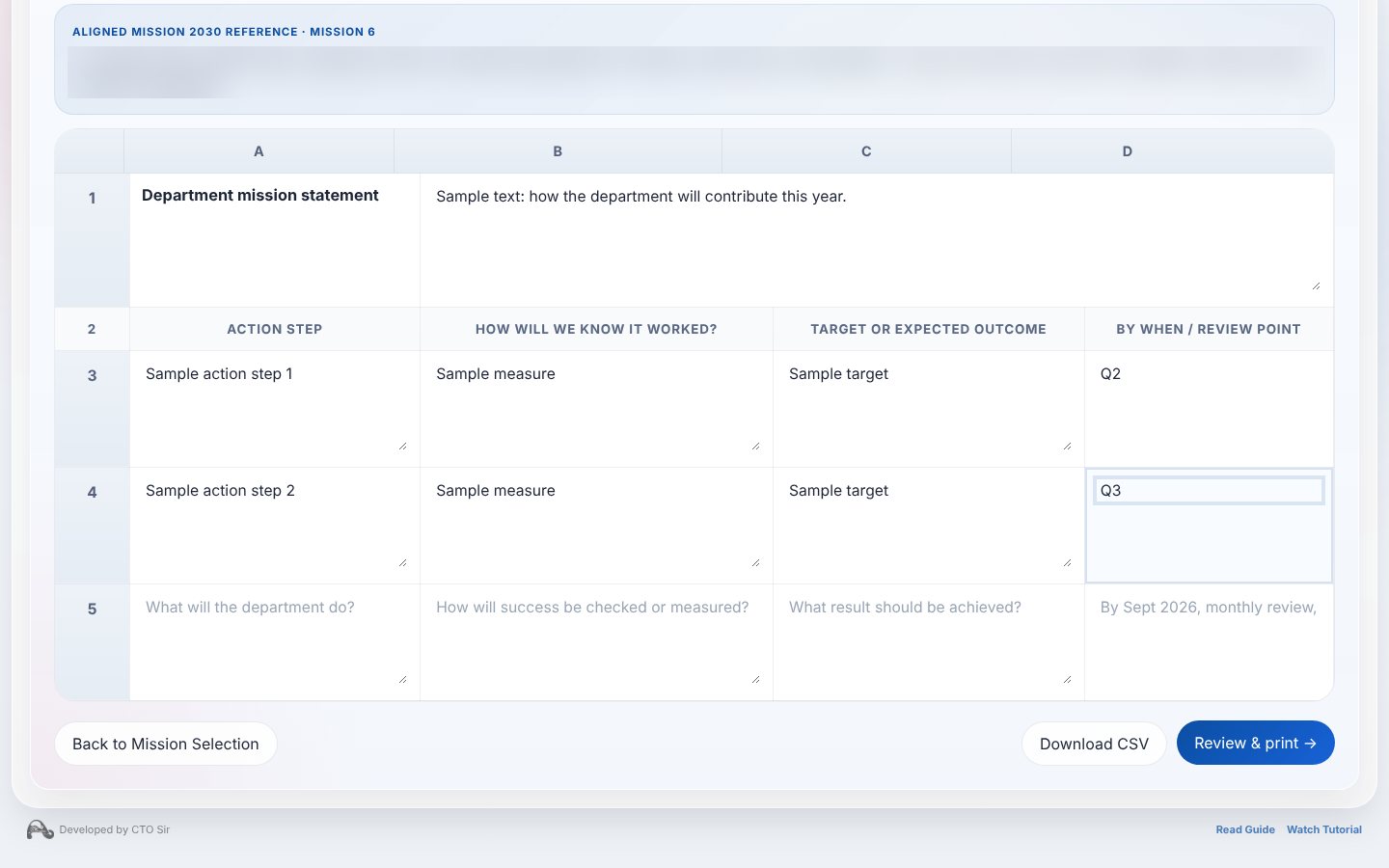
    Fill the worksheet

    You
    Writes the department mission and action rows
    It answers
    Saves as you type: action, measure, target and review point
    A worksheet grid with a mission statement row and two filled action rows
  4. 04 / 06

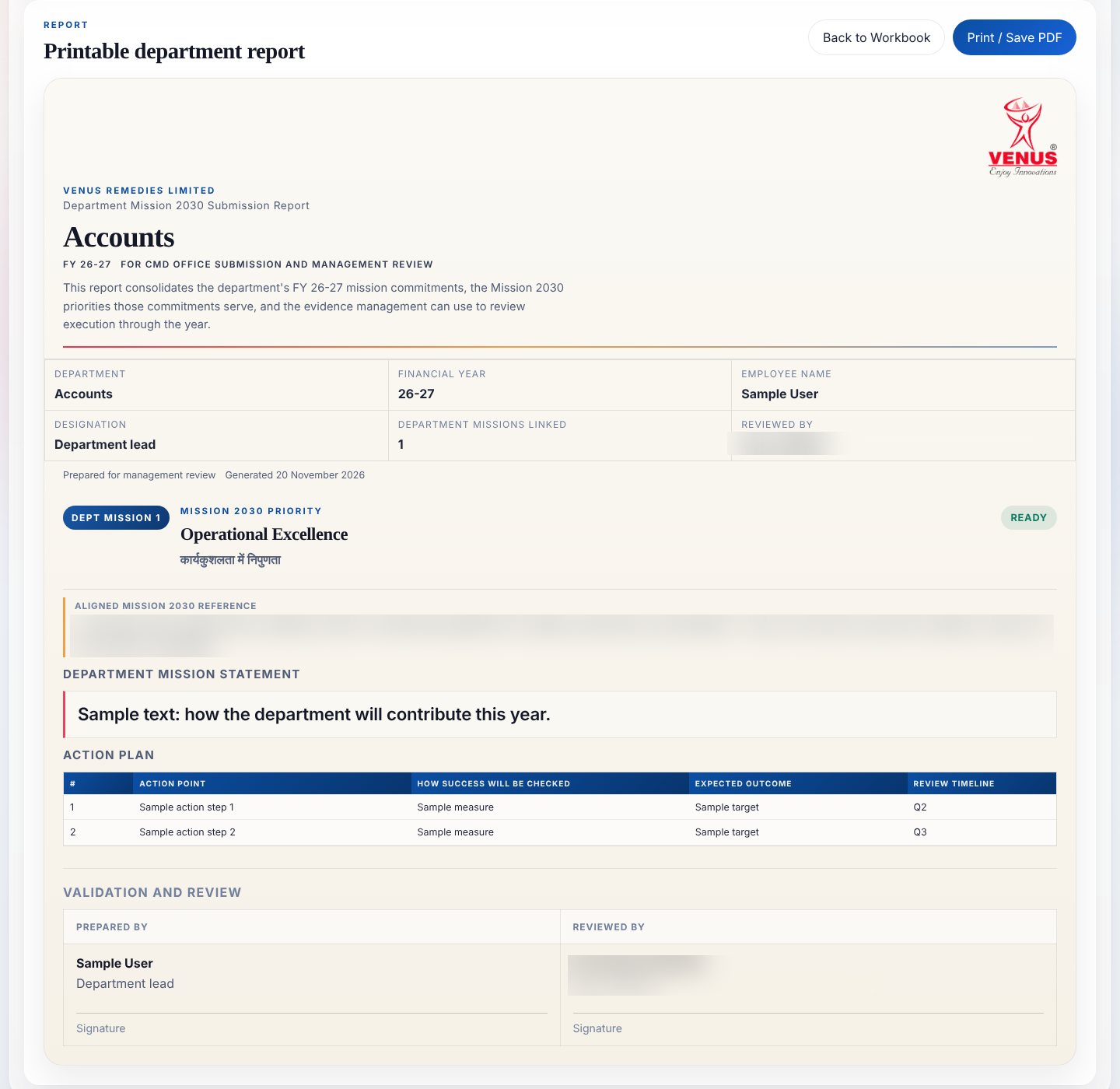
    Review the report

    You
    Opens the Report tab
    It answers
    Assembles a print-ready submission with the reviewing head filled in
    The printable department report with a metadata table, an action plan and sign-off block
  5. 05 / 06

    Print or export

    You
    Prints to PDF or downloads the CSV
    It answers
    Gives management a document and structured data for later reporting
  6. 06 / 06

    Get help

    You
    Opens the manual or the tutorial video
    It answers
    Walks a team through the steps without a guide in the room

03 · What was special

What it stands on

  1. Local-first by choice

    Workbooks live in the browser: no login, nothing to host. The trade-off is that the data stays on one device.

  2. One statement, many slots

    Several department missions can serve the same corporate statement, so work is not forced into one-to-one boxes.

  3. The report fills itself

    The reviewing head is set from the department chosen, across all 85 departments.

A plan that lives in the workbook, not on a slide.

Making-Of

A mission only lives where a department can edit it.

The first commit

  1. The world before

    Mission 2030 was agreed at the top. Each department still had to turn it into yearly work, and management needed to review that work in one shape.

  2. One day

    13 March 2026. The first commit shipped the workbook app and its report layout.

  3. Because of that

    1. Print layout and PDF typography were fixed for a management submission (30 March).
    2. A full audit of accessibility, motion and copy was applied (31 March).
    3. Coverage grew to all 85 departments, with the right reviewing head per department (3 April).
    4. A tutorial video was linked from the home page (3 April).
    5. Slot-based linking let one statement serve several department missions (4 April).
  4. Until finally

    The workbook is launched inside the company; there is no public link.

  5. Since then

    The last commit is 4 April 2026, a rewritten guide. A sibling app for daily progress followed.

The evidence Process, hands, and artifacts

Process

  1. Origin

    First commit: workbook and report layout

  2. Print

    Report layout and PDF typography for submission

  3. Audit

    Accessibility, motion and copy fixes from a design audit

  4. Scale

    All 85 departments, dynamic reviewing heads, tutorial video

  5. Linking

    Slots and one-to-many mission linking with a guided help page

  6. Review

    A written CLEAR review report added to the repository

Hands

Akshansh

  • Concept and the local-first decision
  • Organisation coverage and the report format
  • The tutorial video

Agents

  • ClaudeCo-authored 7 commits
  • AmpCo-authored 6 commits