Back to the shelf

047

Dwaar

Dwaar means gateway. A touch-first kiosk that records every crossing of a sterile area – person, time, direction.

Launched · Started June 2026 · PWA · Notion-First

That's the whole thing.

The site's sound is off. The narration still plays.

This reading didn't load. The transcript is below.

Read the transcript

Dwaar is Hindi for the gateway, the doorway you cross to enter.

A paper register cannot show the order of crossings, or who is inside right now. In a sterile area, that order matters.

Dwaar is a touch-first kiosk at the door. You find your name, tap it, sign on the glass, and submit. The system already knows your direction. No mode to choose. Three to five seconds. Lapsed qualifications are flagged. Visitors register themselves.

Big bold characters. Glove-and-thumb friendly. Warm Hindi cues: andar, bahar.

My standard: highly polished, yet a child could use it. The aim: make the honest record the easiest one. I started in June twenty twenty-six. It is live. Follow along.

Narrated in my own cloned voice, generated with ElevenLabs v4.
Dwaar
No. 047

A paper register at the door of a sterile area can’t show the order in which people crossed, or who is inside right now. In a sterile operation, that order matters.

Dwaar means the gateway, the doorway you cross to enter. I built it in June 2026, vibe-coded with AI, for a sterile manufacturing area at a pharma company. It has one job: capture the true crossing, the person, at the time, in the direction, with so little friction that the honest record becomes the easiest one.

The interface is a touch-first tablet kiosk. You find your name on the area’s roster tiles, tap it, sign on the glass, and submit. Three to five seconds. Dwaar already knows whether you’re going in or coming out, so the button labels itself. There’s no mode to choose.

A live board shows who is inside right now, by department, with time in. Every crossing is time-stamped in a full ledger. Reports are printable. The system works offline and syncs. Visitors register themselves. If a qualification has lapsed, the system flags it.

The characters are big and bold, sized for a gloved thumb. The interface speaks English first, with warm Hindi cues: andar when you go in, bahar when you come out. My standard: highly polished, yet a child could use it.

It’s live. The link is on this page.

The making

  • HTML
  • CSS
  • TypeScript
  • React
  • Next.js
  • PostgreSQL
  • Prisma
  • Tailwind CSS
  • Zustand
  • PWA

01 · The problem

Before it existed

What hurt

A paper register at the door of a sterile area is written to look right. It cannot show the order people crossed in, or who is inside now.

Who uses it

  • Operators
  • QA reviewers
  • Supervisors
  • Visitors
  • Auditors
  • 105commits in ten weeks
  • 11pull requests
  • 76automated tests
  • 3–5 starget per crossing

02 · The flow

7 steps, in the order they happen

  1. 01 / 07

    Pick the door

    You
    Chooses the facility on the shared tablet
    It answers
    Scopes the whole kiosk to that one door and its roster
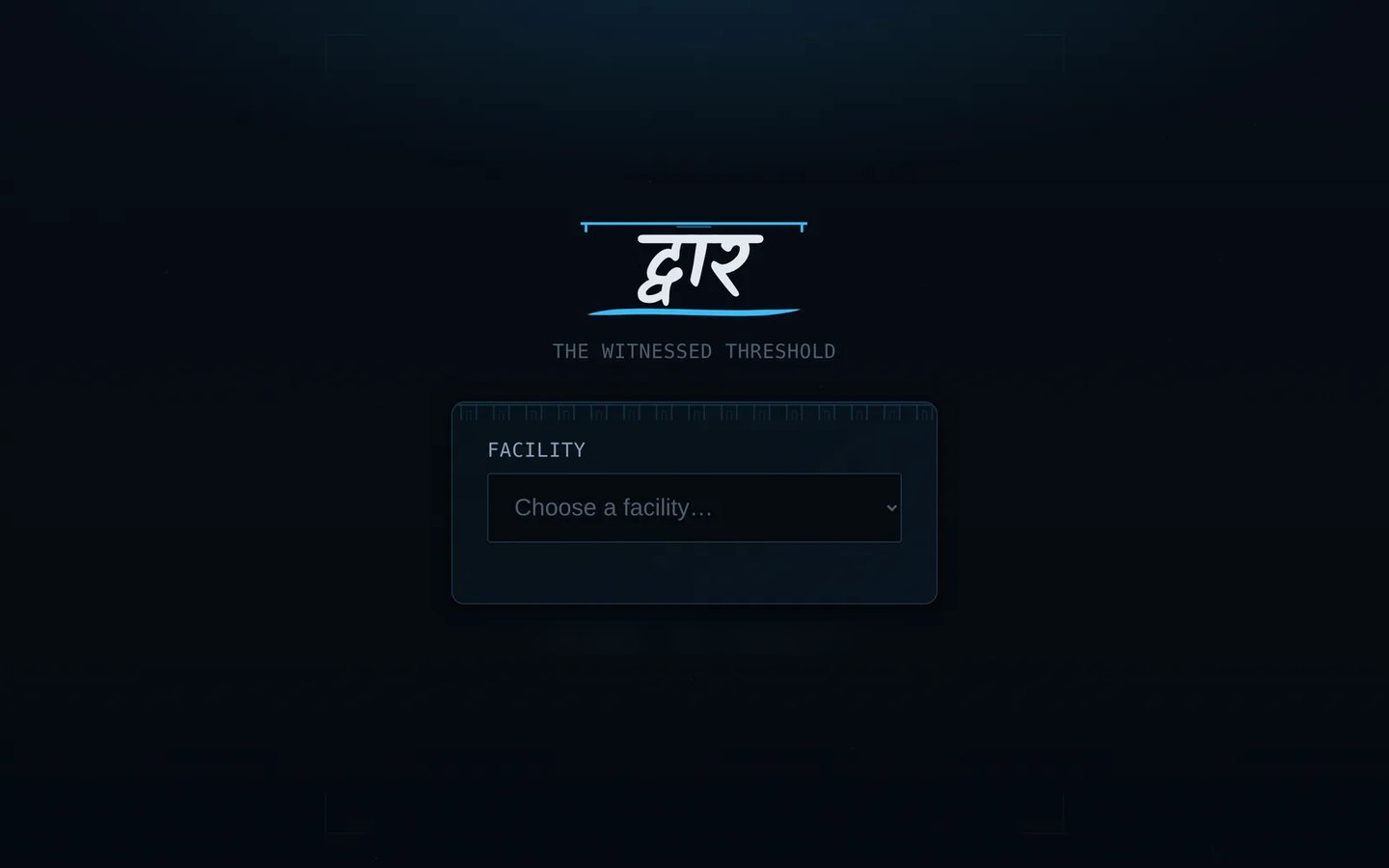
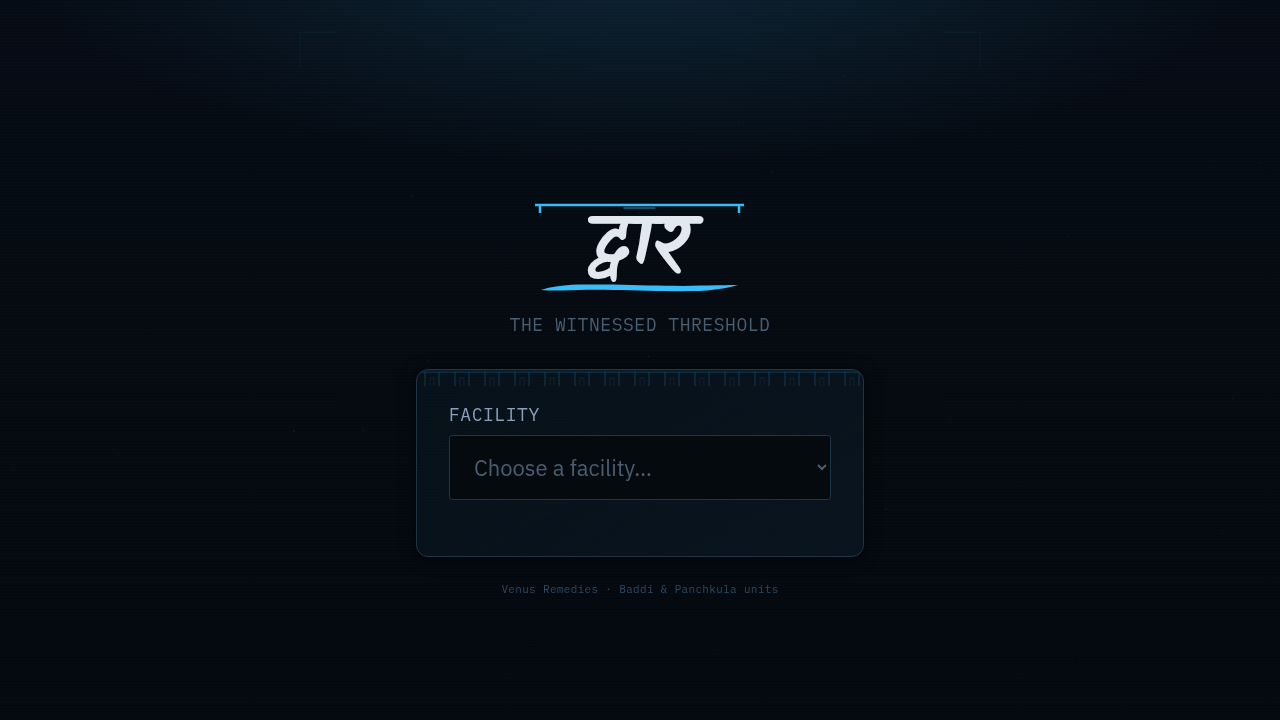
    The kiosk threshold screen with the Dwaar logotype and a facility picker
  2. 02 / 07

    Enter the PIN

    You
    Taps the four-digit facility PIN
    It answers
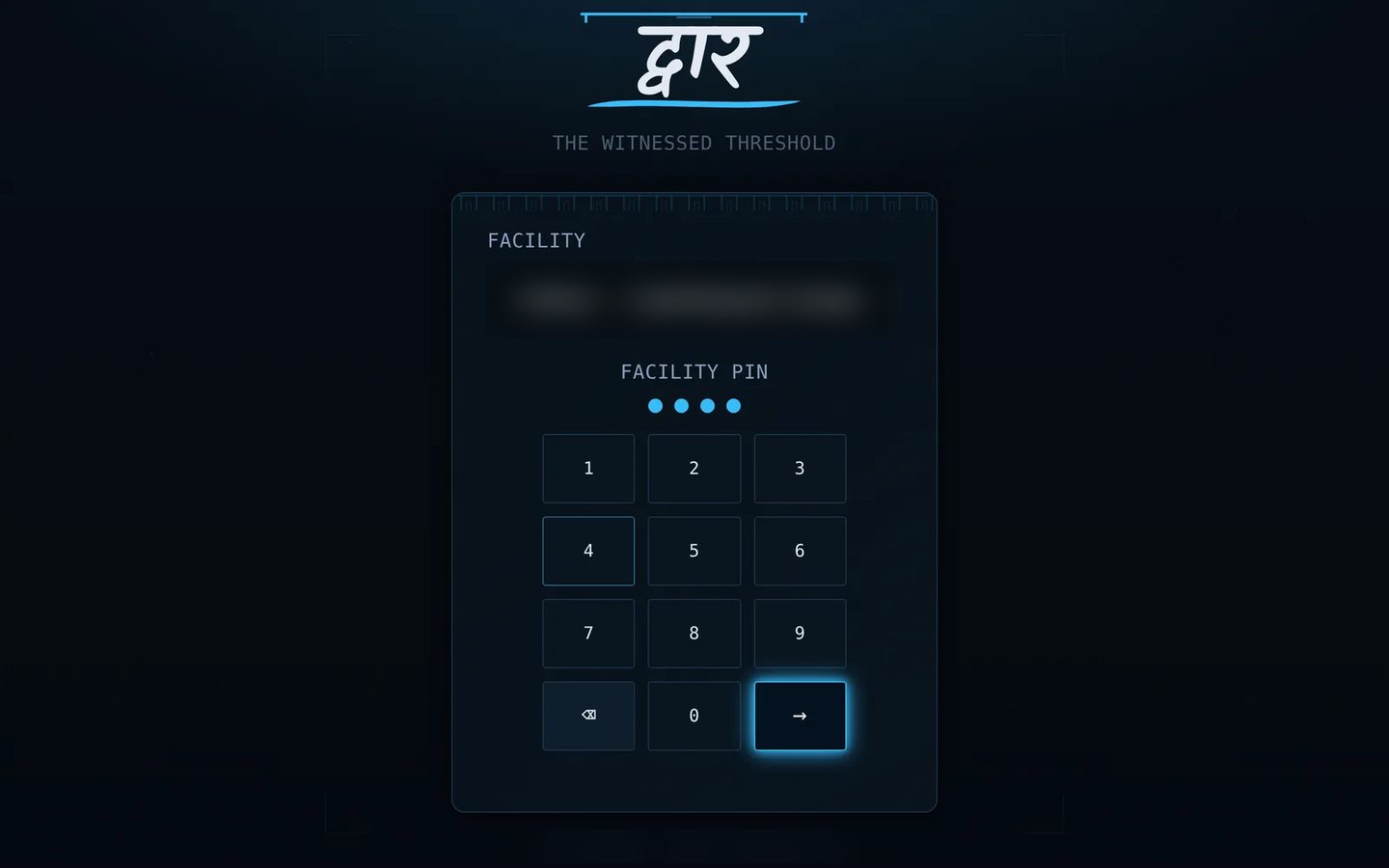
    Opens a signed kiosk session for that door only
    A numeric keypad with four filled dots and a glowing enter key
  3. 03 / 07

    Tap your name

    You
    Finds a name tile and taps it
    It answers
    Reads the last crossing and labels the big button Going IN or Coming OUT
  4. 04 / 07

    Sign on the glass

    You
    Signs once with a finger
    It answers
    Stamps the server time and stores the signature; queues it if offline
  5. 05 / 07

    Watch the gate open

    You
    Waits about a second
    It answers
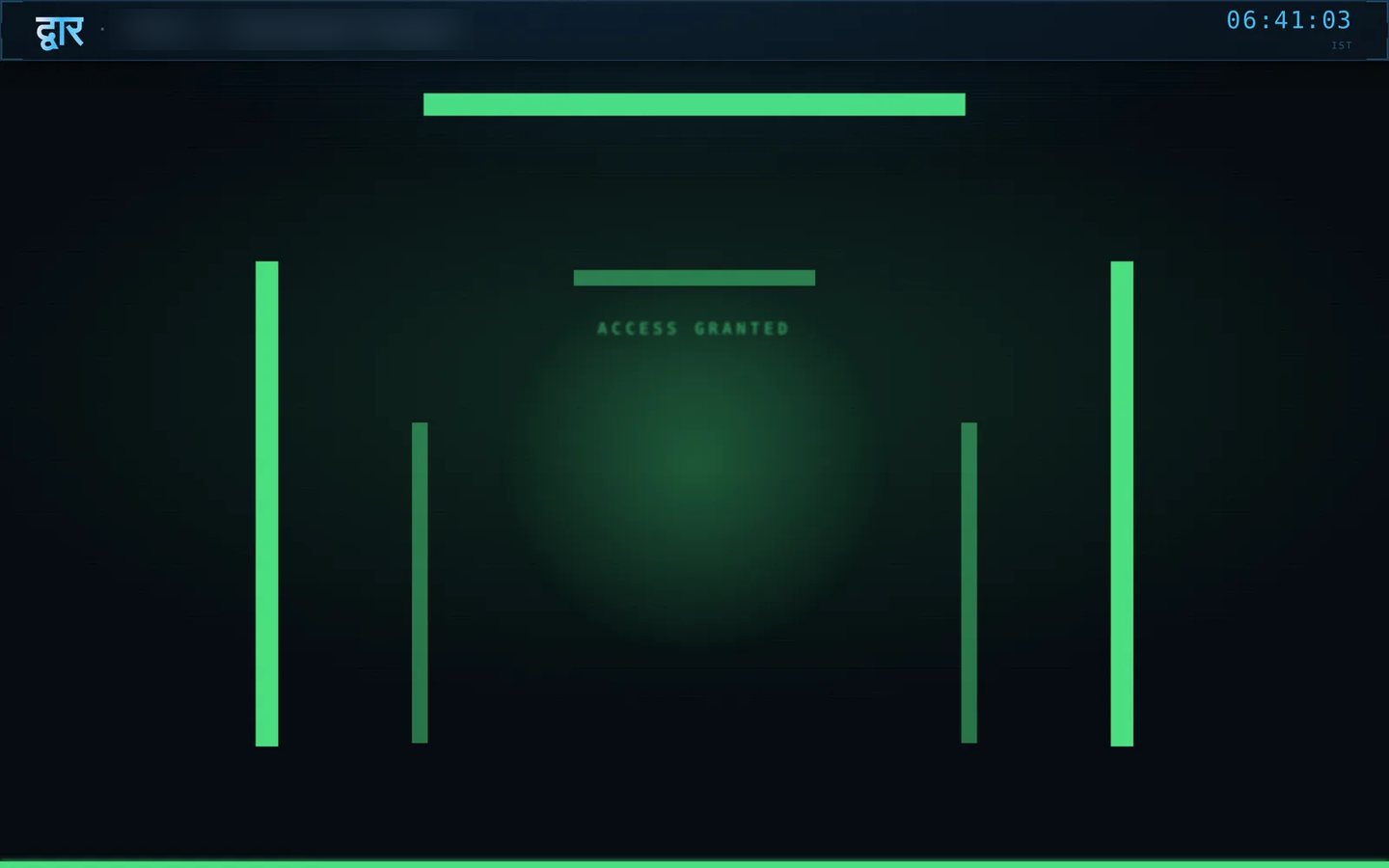
    Opens the gate mark, greets in Hindi and flips the person’s state
    A green gate parting with the words access granted
  6. 06 / 07

    Register as a visitor

    You
    Taps Not on the list, adds a name and category
    It answers
    Records a distinct visitor entry, never an unlogged exception
  7. 07 / 07

    Read the day

    You
    Supervisor opens the admin reports
    It answers
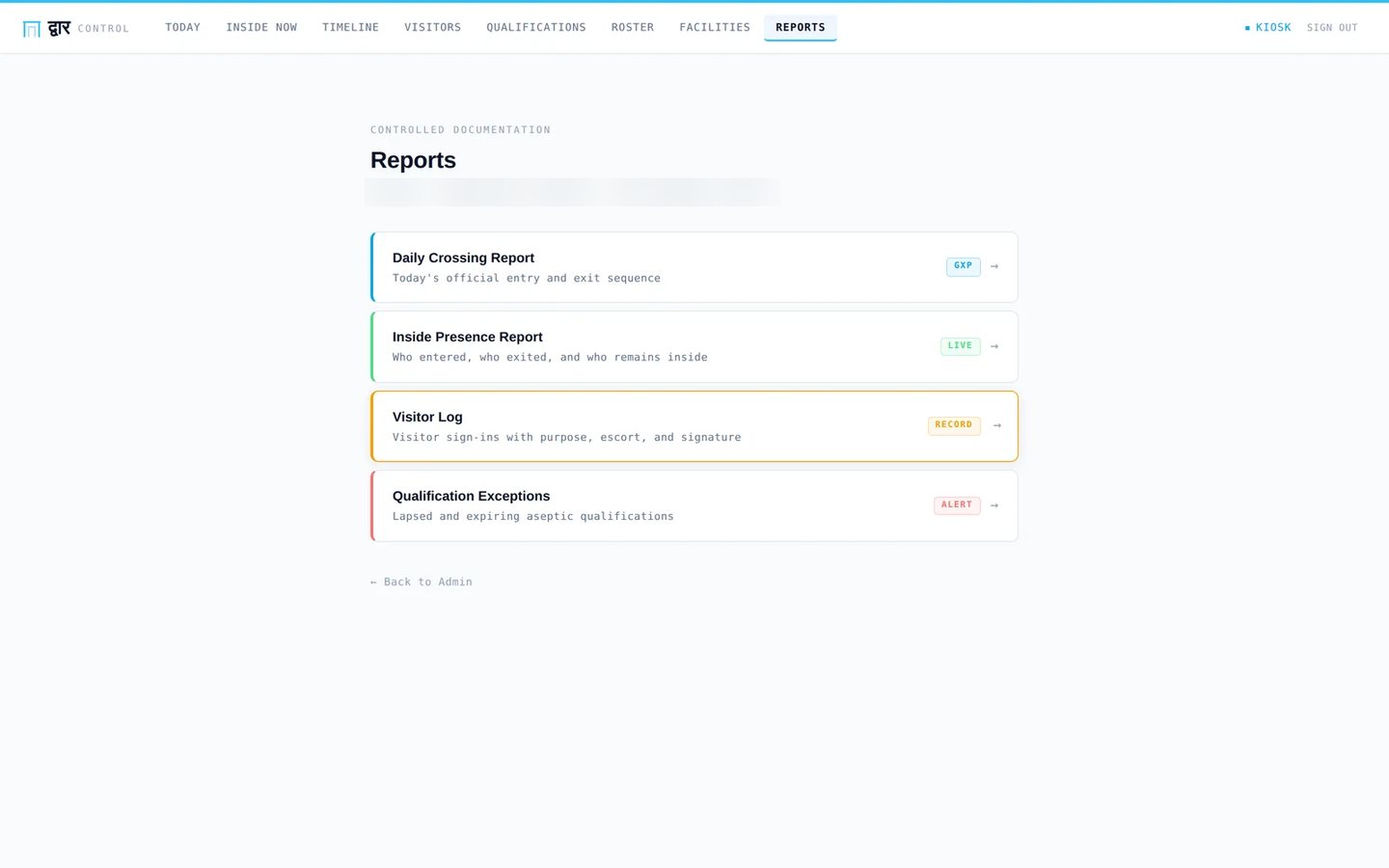
    Prints the crossing ledger, who is inside and the visitor log on A4
    The admin reports index with four report types

03 · What was special

What it stands on

  1. The door knows direction

    No mode to choose. The button labels itself from the person’s last crossing: andar or bahar.

  2. Guides, never blocks

    A lapsed qualification is flagged at the door and in the backend, and the floor keeps moving.

  3. Nothing goes back

    Time is stamped by the server, never typed. The ledger has no edit or delete; a correction is a new event.

The honest record is the easiest one to make.

Making-Of

A paper register looks perfect because it is written to look perfect. Dwaar keeps the real one.

Notion brainstorm kickoff, the same day as the first commit

  1. The world before

    At the door of a sterile manufacturing area the entry logbook looked correct because it was written to look correct. The order in which microbiology, operations, inventory and QA crossed, and who was inside at any moment, could not be recovered.

  2. One day

    26 June 2026. A Notion kickoff set one rule: capture the true crossing, the real person at the real time in the real direction, with so little friction that telling the truth is easier than gaming the logbook. Claude Code built the kiosk, admin portal, reports and data model from that spec the same day.

  3. Because of that

    1. The door learned direction: the button labels itself Going IN or Coming OUT from each person’s last crossing (26 June).
    2. Qualification became a live guardrail that warns and never blocks (26 June).
    3. The kiosk was scoped by unit and facility, with a PIN alternative to the signature (6 and 15 July).
    4. Sound was scored as brass and wood, one motif, with IN rising and OUT as its reverse (12 July).
    5. Error pages became a sign-on-glass game, The Door That Isn’t (24 July).
    6. A brand mark of two doorways in series reached production on 19 August, after the branch was found unmerged.
  4. Until finally

    Dwaar is live on Railway for an aseptic block. On 1 September 2026 the Build Log records that the tablets are in.

  5. Since then

    The last commit is 31 August 2026, an animated replay of the signature as ink on the success screen.

The evidence Process, hands, and artifacts

Process

  1. Origin

    Replace a back-filled paper log with a shared tablet kiosk

  2. Decisions

    Signature only, soft-warn on lapsed qualification, standalone, named Dwaar

  3. Build

    Kiosk, state engine, admin portal, A4 reports and offline queue

  4. Guide

    Public interactive guide with a working kiosk simulator

  5. Sound

    Score bible: brass and wood, no voice by default

  6. Scale

    Unit and facility model, PIN as an alternative to signature

  7. Brand

    Gate mark merged to main; deploy repointed from the feature branch

  8. Launch

    Declared done; tablets in at the door

Hands

Akshansh

  • Concept and the honest-record standard
  • Every locked decision, and the bilingual voice
  • Sound and brand direction, sign-off of each order

Agents

  • Claude CodeBuilt the product from the Notion spec
  • CursorExecuted dispatched briefs: facility UI, kiosk login, error pages
  • ElevenLabsGenerated the sound palette