Back to the shelf

051

Parakh

Every asset, qualified for life. Its state of qualification provable at any instant.

Building · Started July 2026 · System · Notion-First

That's the whole thing.

The site's sound is off. The narration still plays.

This reading didn't load. The transcript is below.

Read the transcript

Parakh means the assay. A parakhi rubs gold against a touchstone and reads the streak.

At the pharma company I work with, every instrument, machine, facility, and utility is validated throughout its life, its qualification provable at any instant. The whole lifecycle was an Excel calendar and hand-typed Word protocols.

Each asset is a timepiece. A validation winds it. When it runs down, the movement stops.

Two rules: nothing that can be computed is ever typed. No date is ever invented. Protocols run on a tablet. The summary report writes itself from locked data.

I started in July twenty twenty-six, documentation first. It is live, still being built, and being validated by the team who will use it. Follow along if this matters to you.

Narrated in my own cloned voice, generated with ElevenLabs v4.
Parakh
No. 051

Parakh means the assay. The act of testing a thing to establish its quality. A parakhi is an assayer who rubs gold against a touchstone and reads the streak.

That image felt right for what I was building: a validation lifecycle system for every instrument, machine, facility and utility at the pharma company I work with. Each asset is qualified the first time, then re-proved on a cycle, for as long as it lives. Its state of qualification has to be provable at any instant.

The whole lifecycle was manual before this. A large Excel calendar. Hand-typed Word protocols and summary reports.

I kept returning to the idea that every asset is a timepiece. Its qualification is stored energy. A validation winds it. When it runs down, the movement stops.

Parakh is built on an append-only qualification ledger. Due dates, the calendar, overdue detection and the annual plan are all derived from it. Two rules hold the whole thing together: nothing that can be computed is ever typed, and no date is ever invented. Protocols are executed on a tablet. The summary report writes itself from locked data.

I started in July 2026, documentation first. Parakh is feature-complete and live, and still being built. The team who will use it is now validating it, and their feedback shapes what comes next. Follow along if that matters to you.

The making

  • TypeScript
  • React
  • Next.js
  • Node.js
  • PostgreSQL
  • Prisma
  • Tailwind CSS
  • Zustand
  • Vitest
  • Ed25519

01 · The problem

Before it existed

What hurt

Validation at the plant ran on a 194 MB Excel calendar, hand-typed Word protocols, and binders. Nobody could prove an asset’s state of qualification on demand.

Who uses it

  • Validation coordinators
  • Executors at the bench
  • Reviewers and approvers
  • Quality leadership
  • 114commits in three months
  • 58pull requests
  • 168equipment IDs in the asset master
  • 1ledger writes every qualification state

02 · The flow

7 steps, in the order they happen

  1. 01 / 07

    Sign in to the bench

    You
    Opens Parakh with a username
    It answers
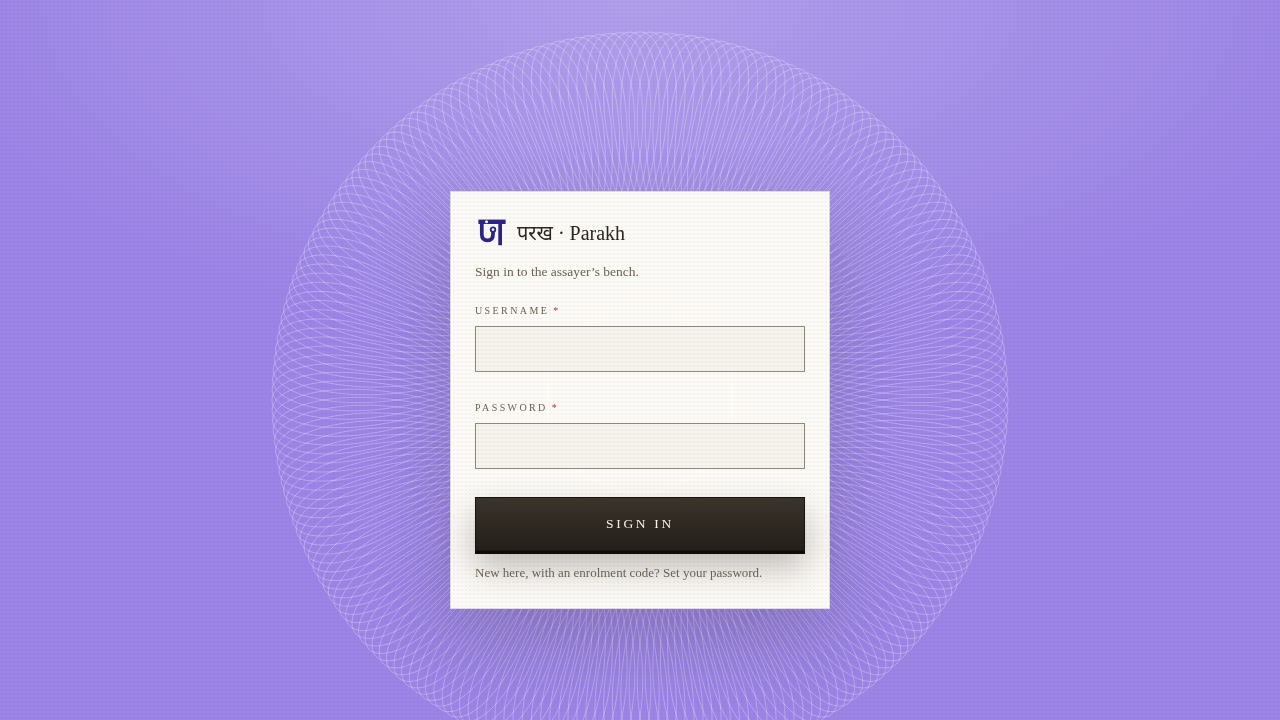
    Gives each person their designation and what they may sign
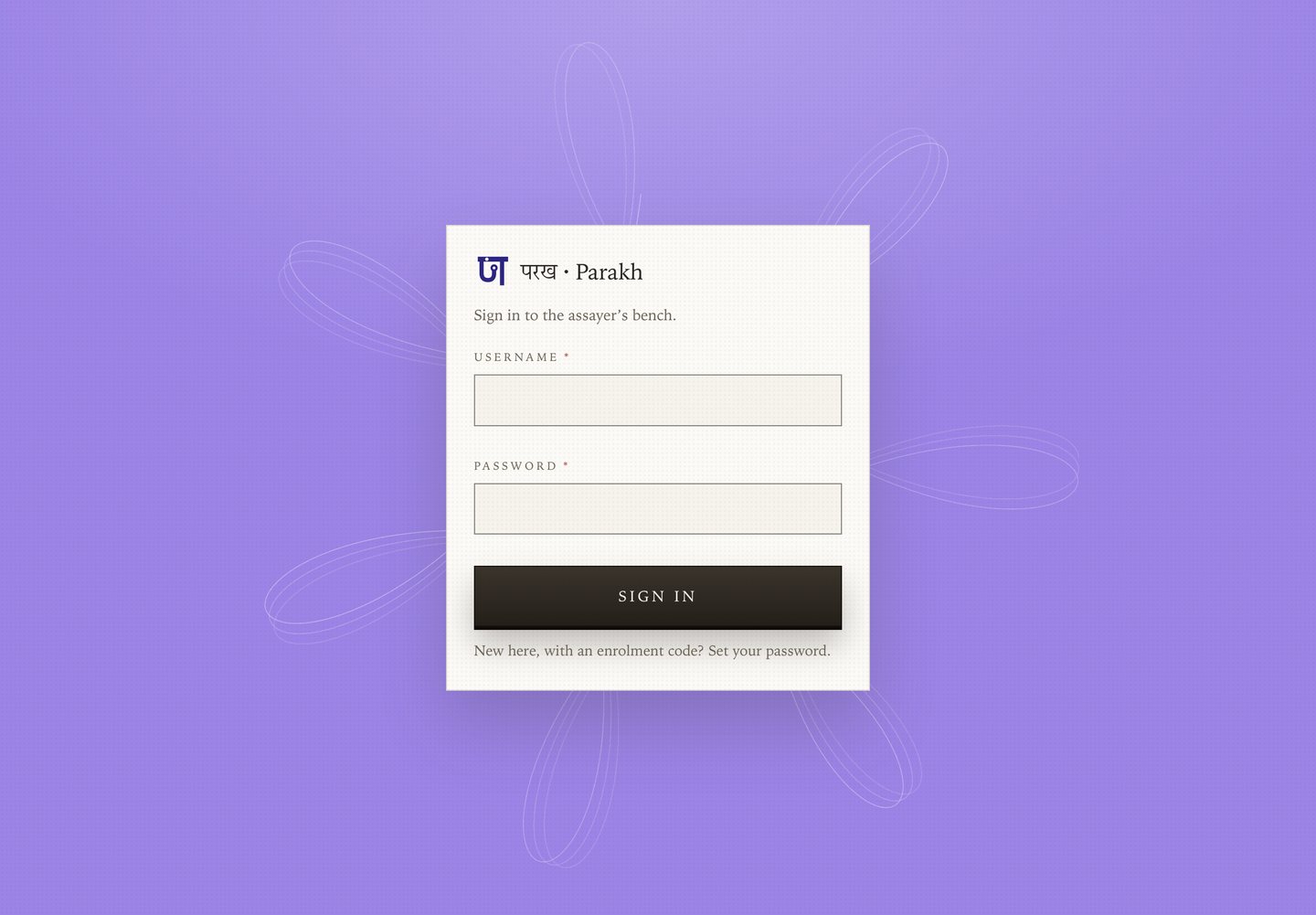
    A violet sign-in screen with a small card reading Sign in to the assayer’s bench
  2. 02 / 07

    See what is owed

    You
    Opens the due list
    It answers
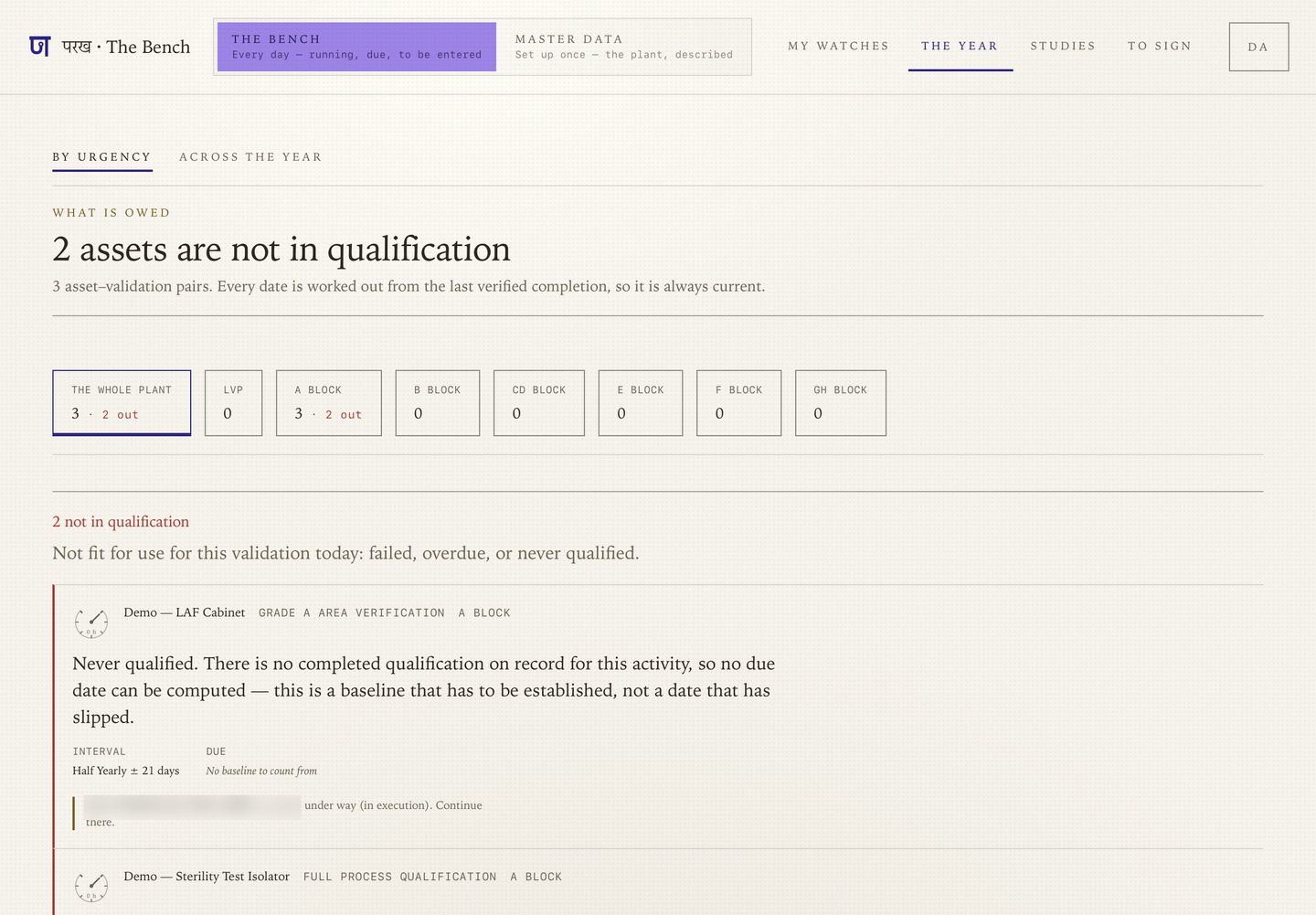
    Works out every date from the last verified completion; never typed
    The due list headed 2 assets are not in qualification, with block filters
  3. 03 / 07

    Read the year

    You
    Switches to the calendar
    It answers
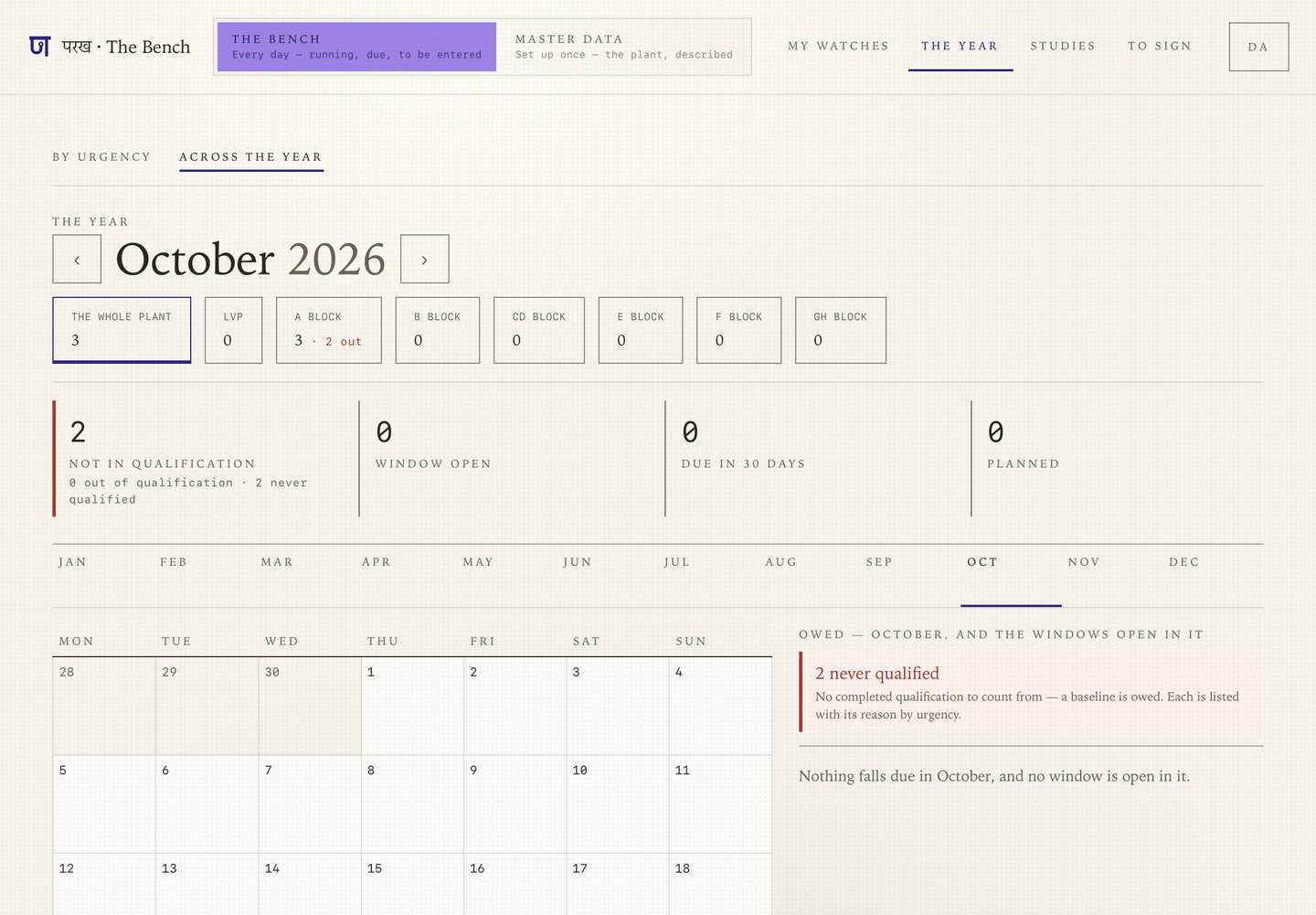
    Shows what falls due each month and which windows are open
    A month calendar for October 2026 with tiles for overdue, open and planned
  4. 04 / 07

    Record the readings

    You
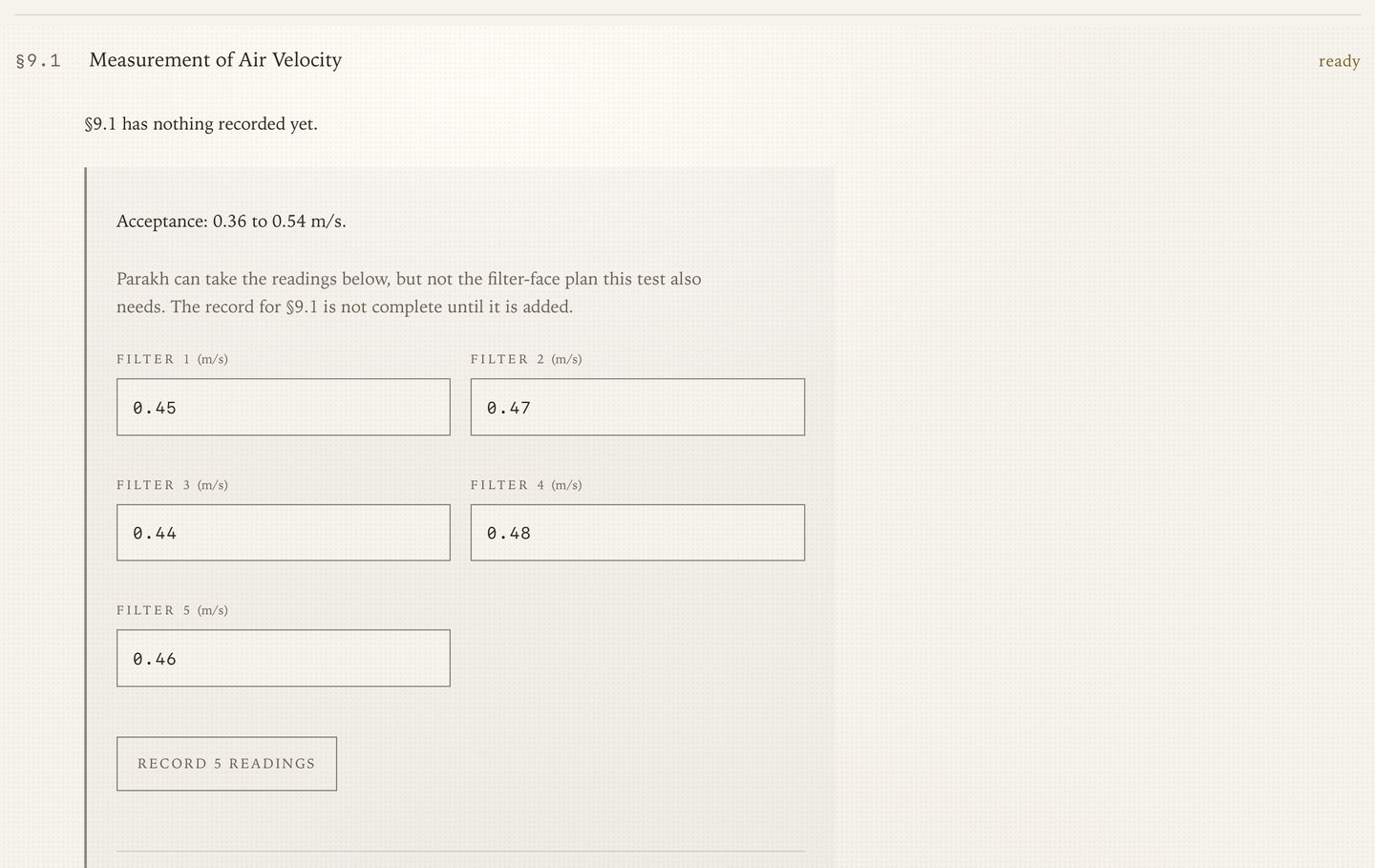
    Types five readings on the tablet
    It answers
    Computes the average and checks it against the acceptance range
    A test section with five numeric filter fields and a record button
  5. 05 / 07

    Judge what falls outside

    You
    Reads the flagged value, chooses a disposition
    It answers
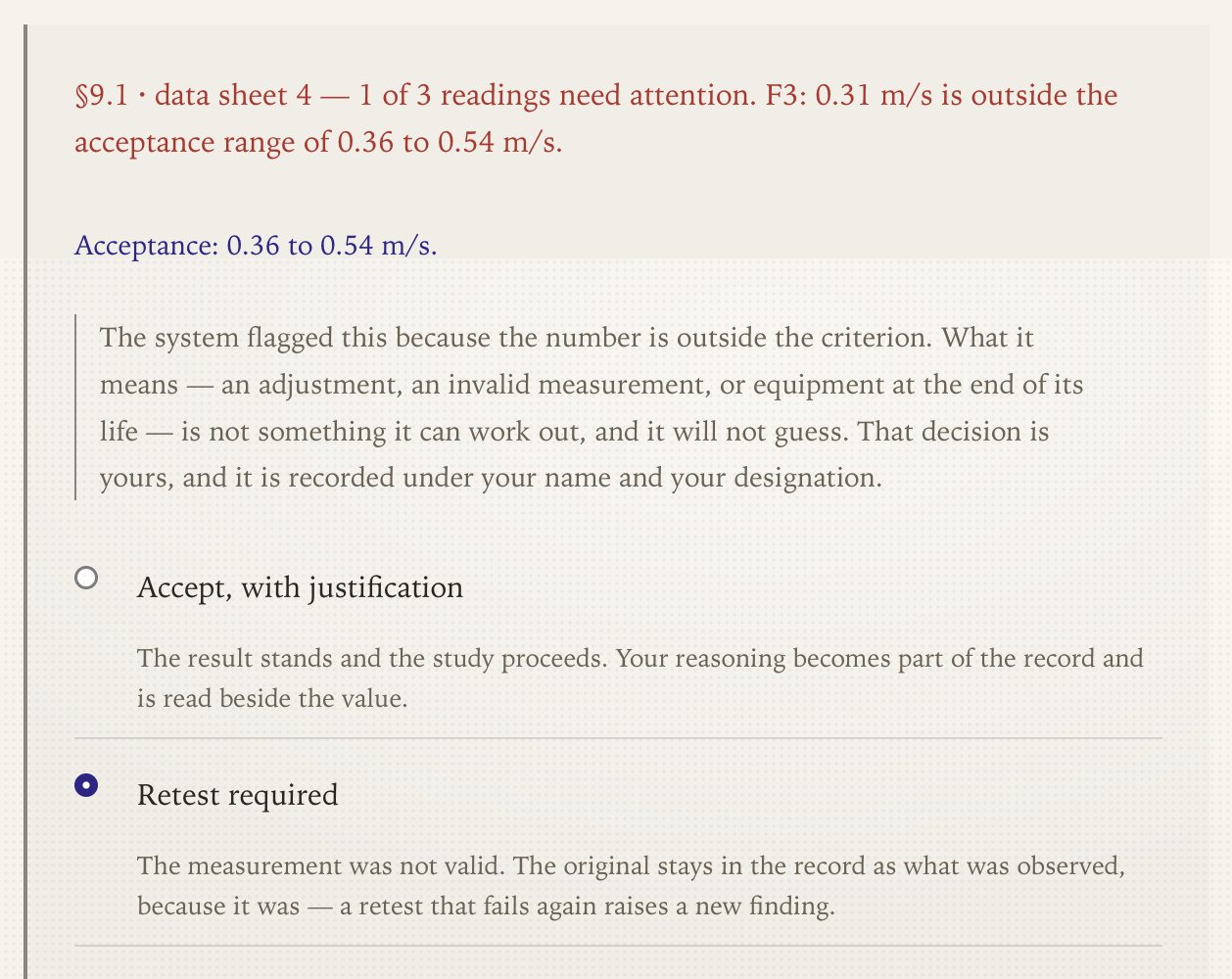
    Flags it automatically but never decides; the judgement is signed
    An out-of-criteria value with options to accept, retest, fail or escalate
  6. 06 / 07

    Sign by designation

    You
    Signs at their stage in the chain
    It answers
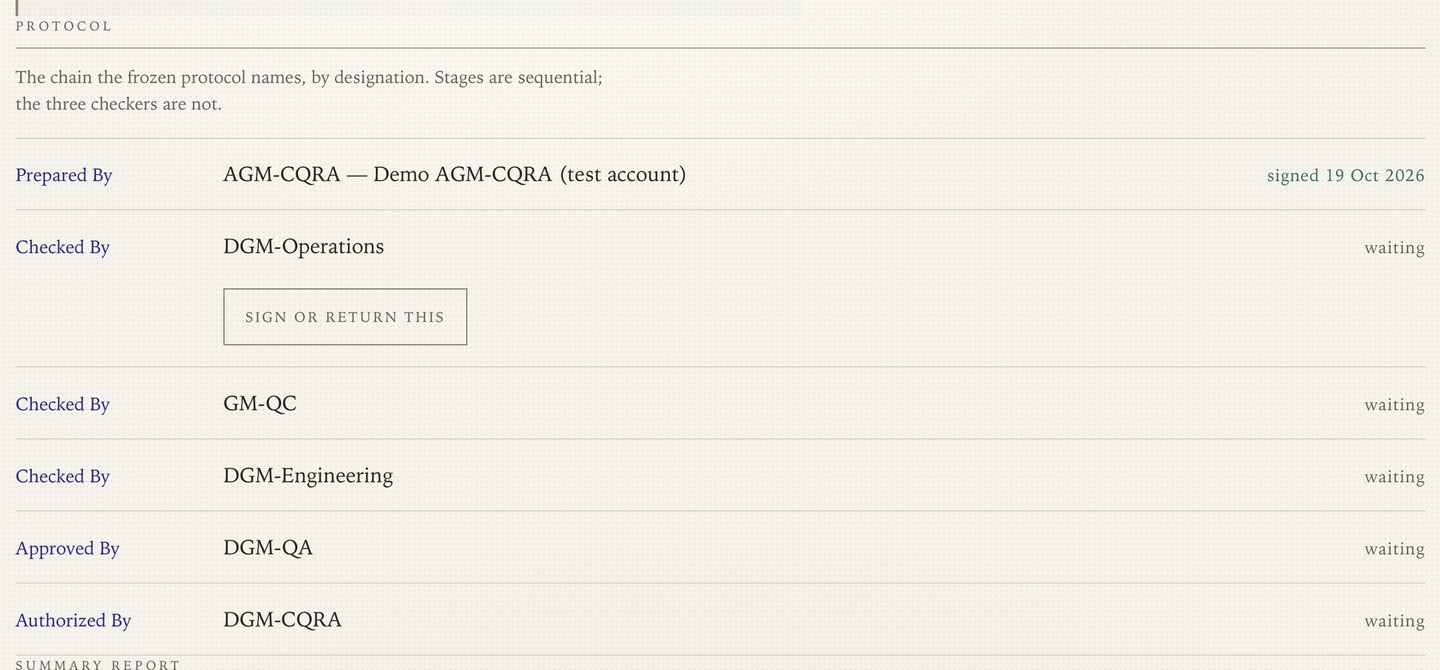
    Covers the record as it stands; later change breaks the signature
    The approval chain: prepared, three checkers, approved, authorized
  7. 07 / 07

    Read the summary report

    You
    Opens the finished study
    It answers
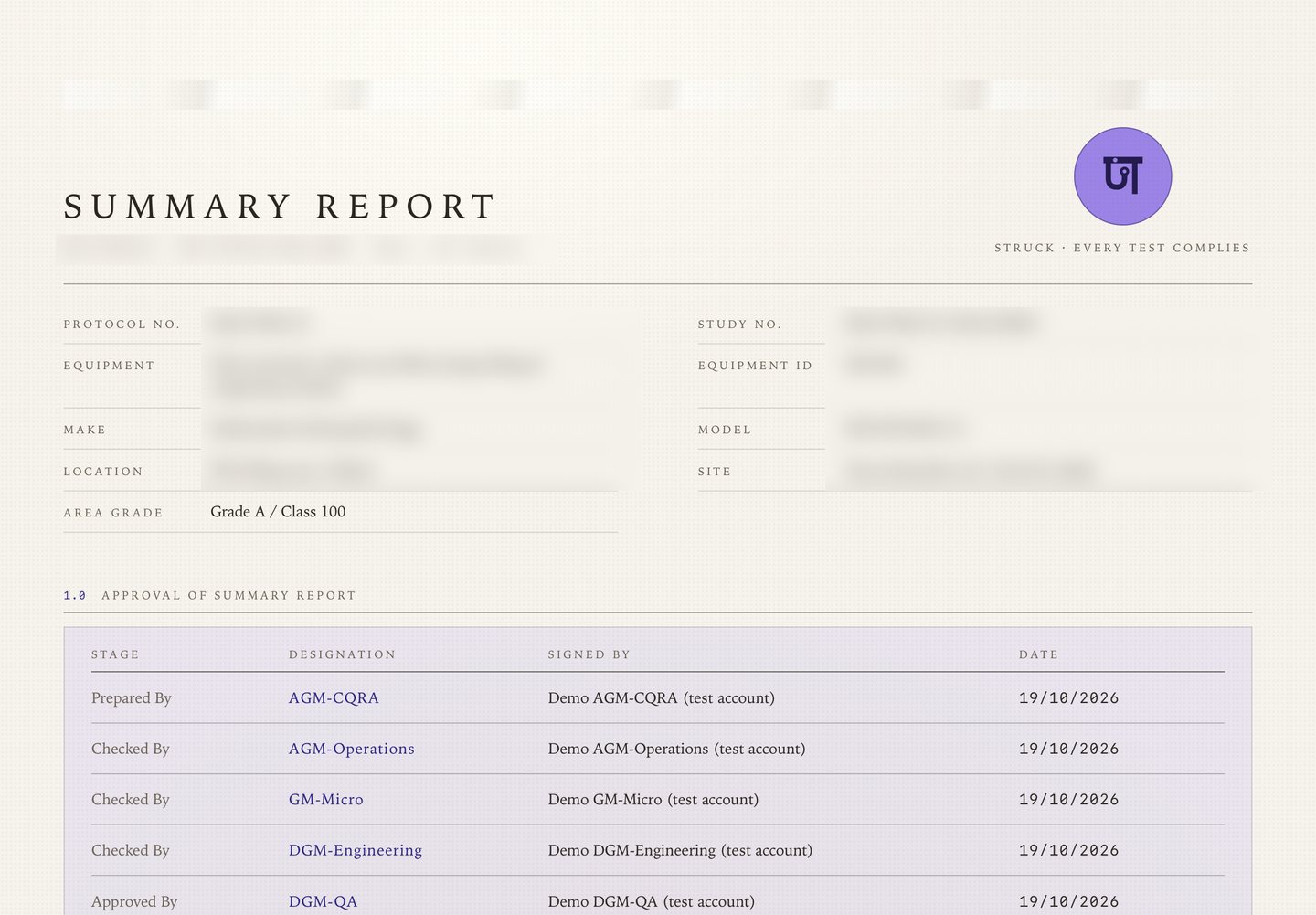
    Writes the report from locked execution data
    A summary report with approval table; equipment fields blurred for privacy

03 · What was special

What it stands on

  1. One ledger, sole writer

    Due dates, calendar, overdue flags, and the annual plan are all derived from an append-only qualification ledger.

  2. Every asset is a watch

    Each study draws a watch as it is built. A validation winds it; when it runs down, the movement stops.

  3. Gates, not reminders

    Calibration and training must hold for the whole planned window, or the study is refused with the reason.

Nothing that can be computed is ever typed.

Making-Of

A spreadsheet can say an asset is qualified. Parakh can show why, at any instant.

The first Notion brief and the first commit, the same day

  1. The world before

    The validation lifecycle for the plant’s instruments, machines, facilities, and utilities was manual: a very large Excel master plan, Word protocols and summary reports, and physical binders for evidence.

  2. One day

    26 July 2026. Documentation first: a design spec, the extracted context from the quality authority’s own files, and a repo scaffold with Postgres and Prisma.

  3. Because of that

    1. The master data UI and the bench, where a protocol is performed on a tablet, landed in two days (28 July).
    2. A template studio let a protocol be authored in the interface (30 July).
    3. The watch became the record: each study draws its own movement (31 July).
    4. A feature-complete version 1 went live; coordinator and reviewer licences went to the team (1 August).
    5. The walkthrough, the books and the hallmark press followed in October (11–19 October).
  4. Until finally

    Parakh is live and in validation with the team who will use it.

  5. Since then

    Their feedback now drives the next orders; integration with the other plant systems is deferred by decision.

The evidence Process, hands, and artifacts

Process

  1. Origin

    Spec and context first, then the scaffold

  2. Master data

    Assets, validation types and people, set up once

  3. Bench

    Protocols performed on a tablet, not watched

  4. Template studio

    A protocol authored in the interface

  5. The watch

    The watch is the record

  6. Release

    Version 1 live; standalone by decision

  7. Brand

    The platform never speaks in its own colour

  8. Hallmark

    A mark is struck only when all three pins stand level

Hands

Akshansh

  • Concept, the derived-ledger rule and every product ruling
  • Design direction: the watch metaphor
  • Review of what the agents built

Agents

  • Claude CodePrimary builder and reviewer
  • CursorCo-authored commits
  • Factory DroidCo-authored commits