Back to the shelf

024

SelectCC

A trust-first credit card comparison tool for premium cards, without the affiliate bias.

Launched · Started January 2026 · PWA · Vibe-Coded

That's the whole thing.

The site's sound is off. The narration still plays.

This reading didn't load. The transcript is below.

Read the transcript

Most credit card comparison sites run on affiliate commissions. That changes the math before you see a number. When annual fees run into the tens of thousands, that bias is a real problem.

I built SelectCC to fix that. I started it in January twenty twenty-six, vibe-coding it with AI. You put in how you actually spend. It shows the projected annual value across premium cards like Infinia Metal and Emeralde Private Metal. It also surfaces cap risk, the likelihood of hitting reward limits, and verification confidence, how trustworthy the data is.

The point is to trust the result, not just get one. It's launched.

Narrated in my own cloned voice, generated with ElevenLabs v4.

Most comparison sites have a problem. They run on affiliate commissions. The card they recommend isn’t always the card that suits you. It’s the card that pays them.

I built SelectCC in January 2026 to compare premium cards like the HDFC Infinia Metal and the ICICI Emeralde Private Metal in a way I could trust. When the annual fee runs into the tens of thousands, a tool you trust matters more than a pretty one.

SelectCC is an installable progressive web app. You put in how you spend, and it shows the projected annual value for each card. That’s the foundation.

It goes further than reward math. SelectCC surfaces cap risk: the likelihood that you’ll hit a reward cap and earn less than the headline number suggests. It also shows verification confidence: how trustworthy the underlying data actually is. You see the reasoning, not just the result.

The model underneath runs on three layers: Spend, Desk and Drawer. There’s a Trust Ledger and a verification policy, and the whole thing was reviewed against my CLEAR framework. The aim is transparency: you should be able to trust the recommendation, not just hope it’s right.

Vibe-coded with AI. Launched.

The making

  • HTML
  • CSS
  • JavaScript

01 · The problem

Before it existed

What hurt

Card comparison sites earn commission, so the recommendation can follow the payout. When the annual fee runs into tens of thousands, I wanted a number I could trust.

Who uses it

  • Me, choosing a premium card
  • Anyone weighing two premium cards
  • 14spend scenarios compared
  • 11benefits filed with caveats
  • 8official sources linked
  • 6commits, January to March 2026

02 · The flow

7 steps, in the order they happen

  1. 01 / 07

    Lay the spend on the desk

    You
    Opens the app on a phone or laptop
    It answers
    Frames the job: pick a spend, see the stronger card, check the proof later
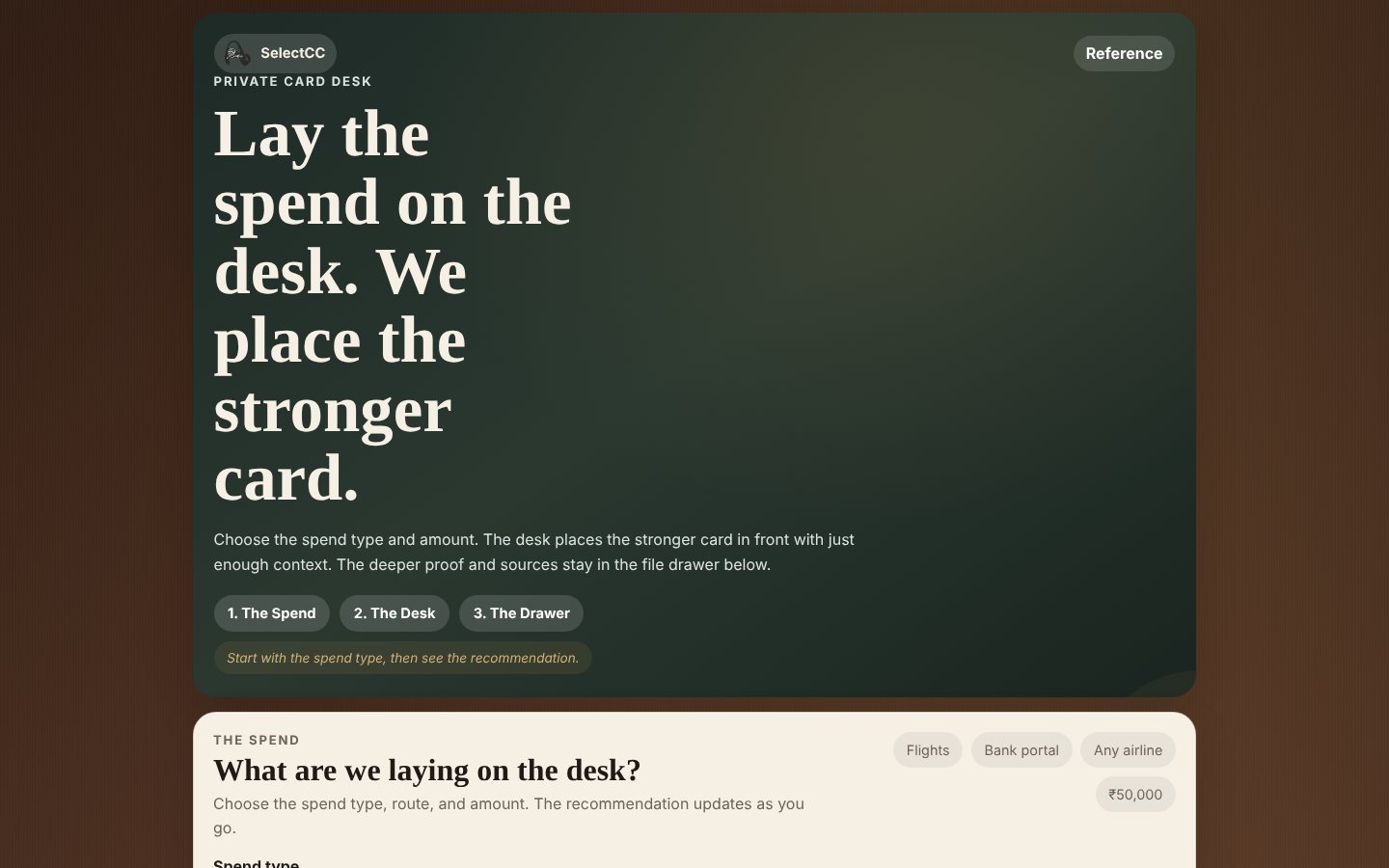
    A dark green card reading Lay the spend on the desk, on a mahogany background, with three numbered steps
  2. 02 / 07

    Describe the spend

    You
    Picks a type, a route, a context and an amount
    It answers
    Recomputes the answer as each choice is made
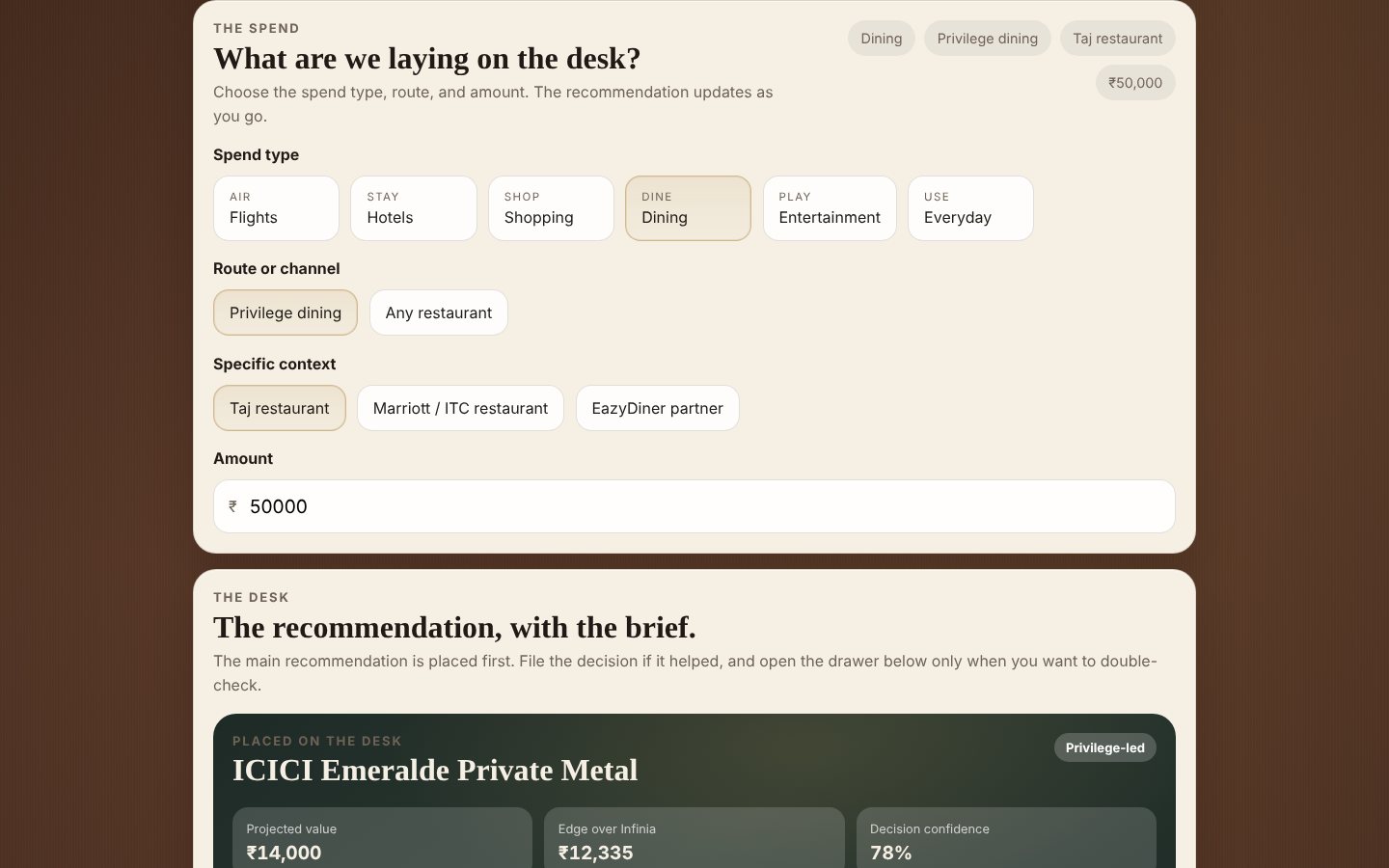
    Choices for spend type, route and context, with dining and a Taj restaurant selected and 50,000 rupees entered
  3. 03 / 07

    Read the recommendation

    You
    Looks at the card placed first
    It answers
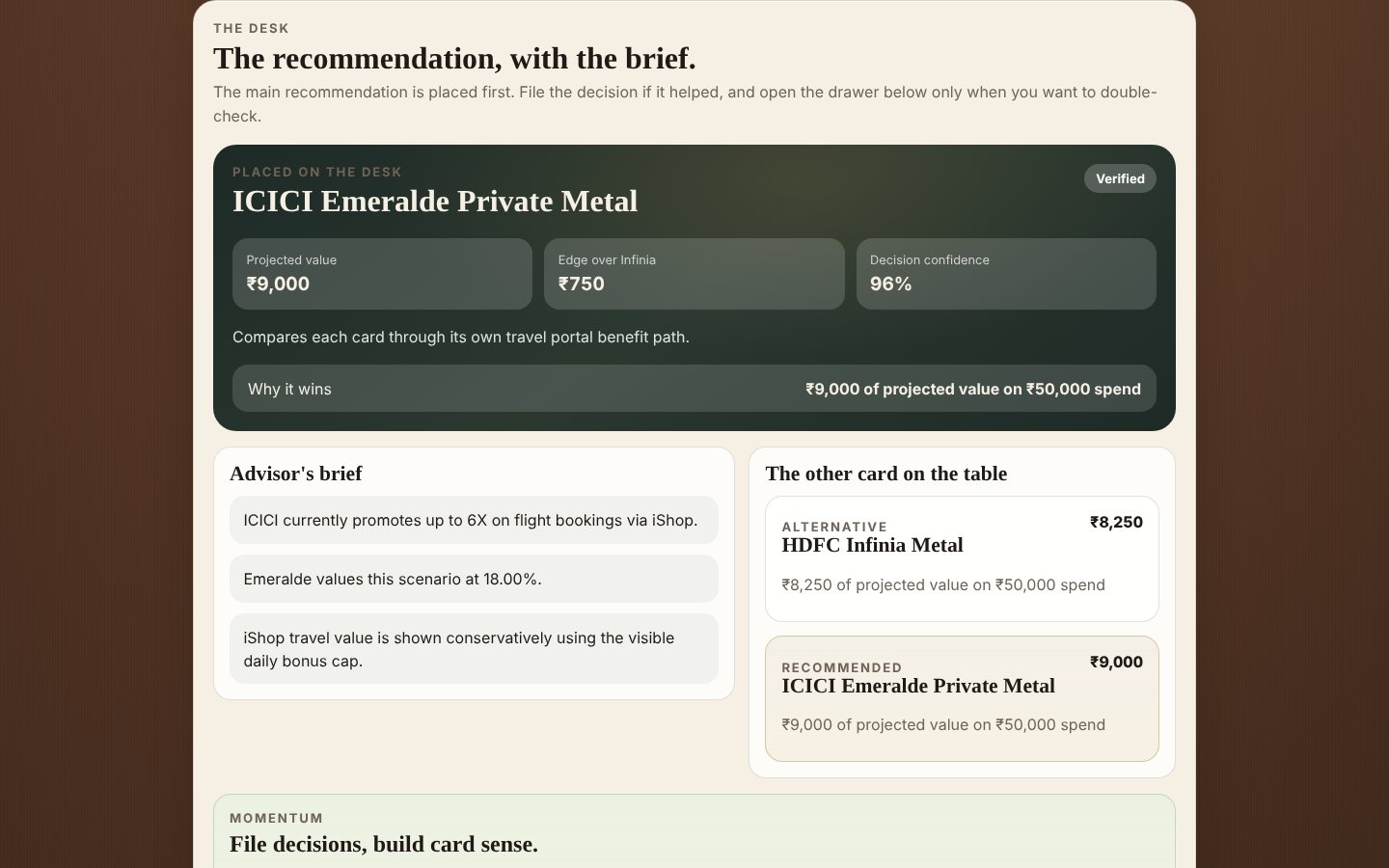
    Shows projected value, the edge over the other card and a confidence figure, with the reason
    A recommendation card with projected value 9,000 rupees, edge 750 rupees and 96 per cent confidence, and the other card beside it
  4. 04 / 07

    See how sure it is

    You
    Switches to a dining spend
    It answers
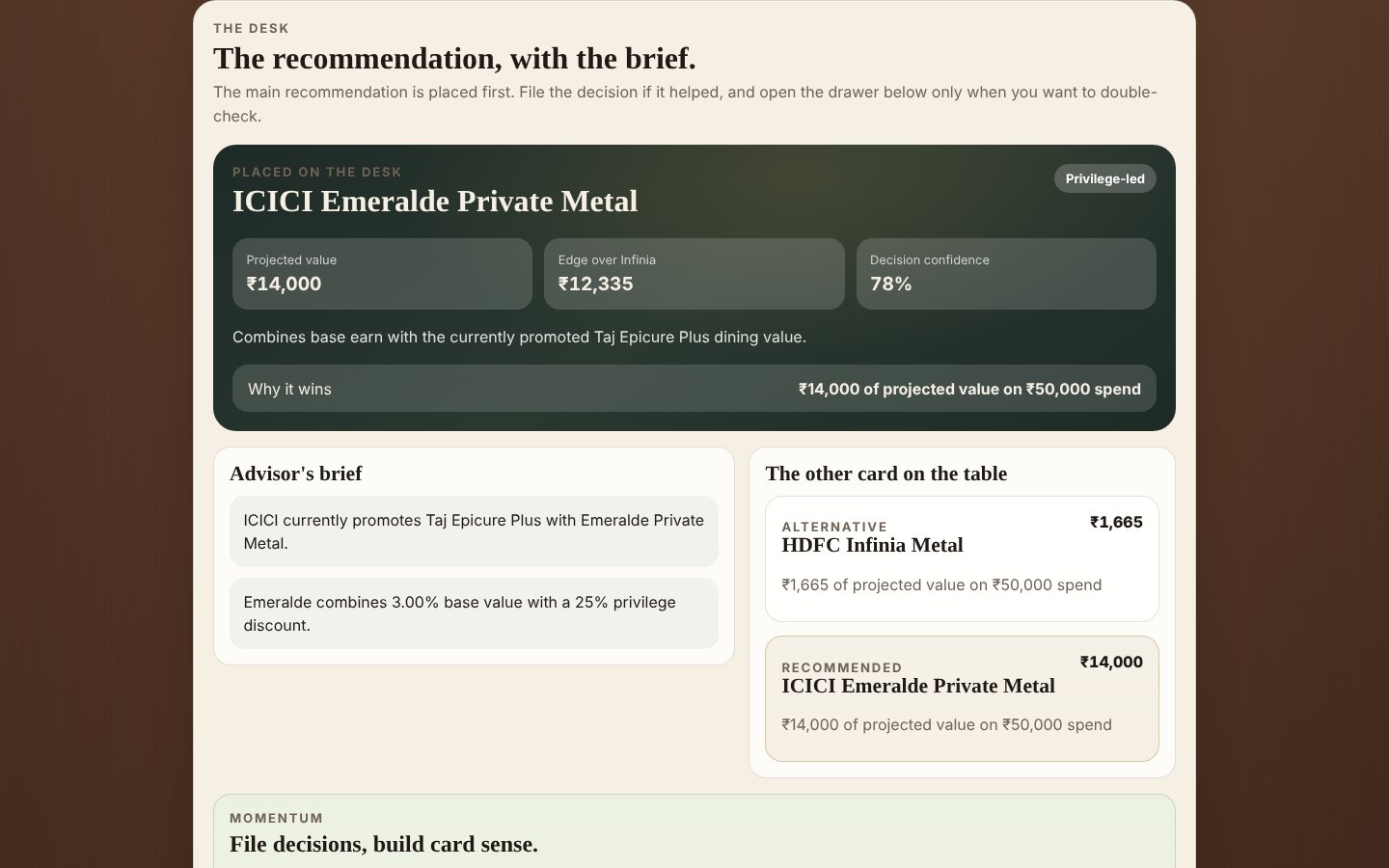
    Labels the answer privilege-led and drops confidence to 78 per cent, because it rests on programme terms
    A recommendation marked Privilege-led with 78 per cent decision confidence and projected value of 14,000 rupees
  5. 05 / 07

    Open the drawer

    You
    Opens benefits and caveats
    It answers
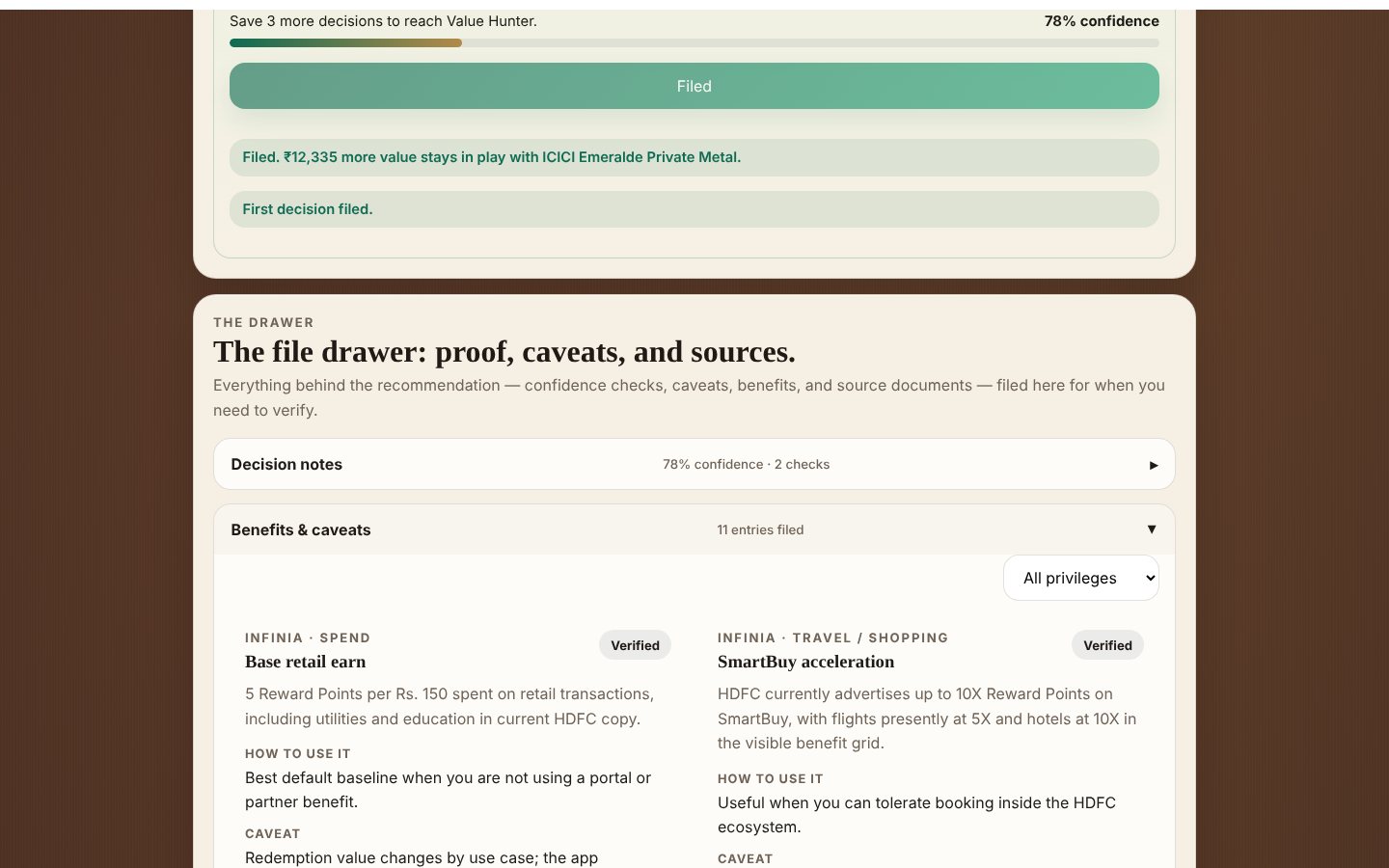
    Lists each privilege with how to use it, its caveat, a trust label and a last-checked date
    A list of card benefits, each marked Verified, with how-to-use and caveat lines
  6. 06 / 07

    File the decision

    You
    Presses Save this comparison
    It answers
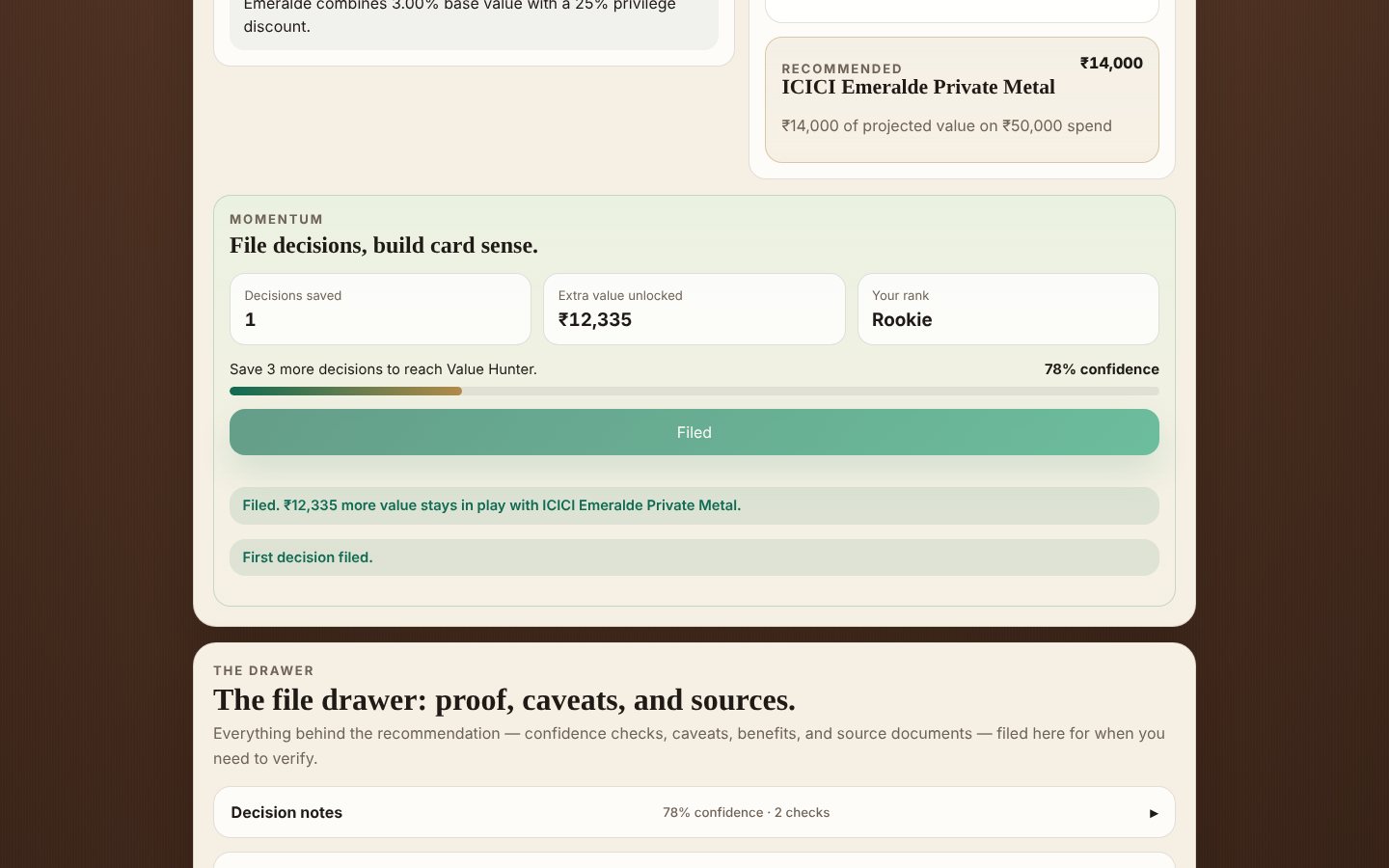
    Counts it toward a rank that climbs from Rookie to Card Maestro
    The save button changed to Filed, with a note that 12,335 rupees more value stays in play and a First decision filed message
  7. 07 / 07

    Use it on the phone

    You
    Opens the installed app
    It answers
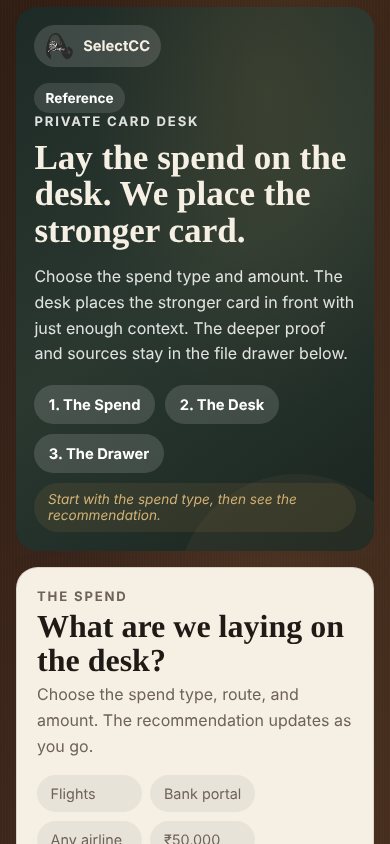
    Stacks the same desk in one column, built phone first
    The phone view: the dark opening card with the three steps stacked

03 · What was special

What it stands on

  1. Confidence is a number

    Every answer carries a confidence figure and a label: Verified, Verified with review, or Privilege-led.

  2. Facts and assumptions kept apart

    A benefit that cannot be backed by an official page is not shown as fact. Caveats sit beside the benefit.

  3. A private banker’s desk

    The interface plays an advisor’s desk – mahogany, leather, brass – so the serious part feels calm, not salesy.

A recommendation that shows how sure it is.

Making-Of

A card comparison with no commission behind it, and honest about what it doesn’t know.

The first commit, the same day as the catalogue entry

  1. The world before

    Premium card comparisons online run on affiliate payouts and thin maths. The headline reward rate hides the caps.

  2. One day

    18 January 2026. A first calculator, HDFC against ICICI, is committed and made ready for Vercel the same day.

  3. Because of that

    1. 18 January 2026: version 1.0 and the Vercel setup, two commits, one day.
    2. 28 February 2026: a round of fixes to the maths and structure.
    3. 22 March 2026: a CLEAR framework pass, with the flow rebuilt phone first and facts split from assumptions.
    4. 29 March 2026: the PLACE and ALIVE frameworks applied – the advisor’s desk, entrance animation, tilt, milestones.
  4. Until finally

    A phone-first, installable app that compares two premium cards and shows its own confidence.

  5. Since then

    The last commit is 29 March 2026. The app is for my own use.

The evidence Process, hands, and artifacts

Process

  1. Origin

    A calculator comparing two premium cards, with research from two AI assistants

  2. Release

    Version 1.0, prepared for Vercel

  3. Fixes

    Compound engineering fixes to calculations and structure

  4. Trust rebuild

    CLEAR pass: phone-first flow, verified facts split from assumptions, installable PWA

  5. Place

    PLACE and ALIVE applied: the advisor’s desk and the progress layer

Hands

Akshansh

  • The question: which card, and how far can I trust the answer
  • The verification policy and the frameworks it is reviewed against

Agents

  • AmpCo-author on three commits, and the CLEAR design review
  • ClaudeOne of two research briefs on the two cards, 18 January 2026
  • ChatGPTThe other research brief, same day