053
Setu
Setu means bridge. It doesn't carry data; it decides who may cross.
This reading didn't load. The transcript is below.
Read the transcript


The name means bridge. That is not an accident. I work on a family of internal applications at a pharma company. They do not talk to each other, at least not without someone deciding who may connect and what is allowed.
Setu decides that. It authorises, issues credentials, and audits each app-to-app bridge. Data still travels directly. Setu never carries it. It just holds the keys.
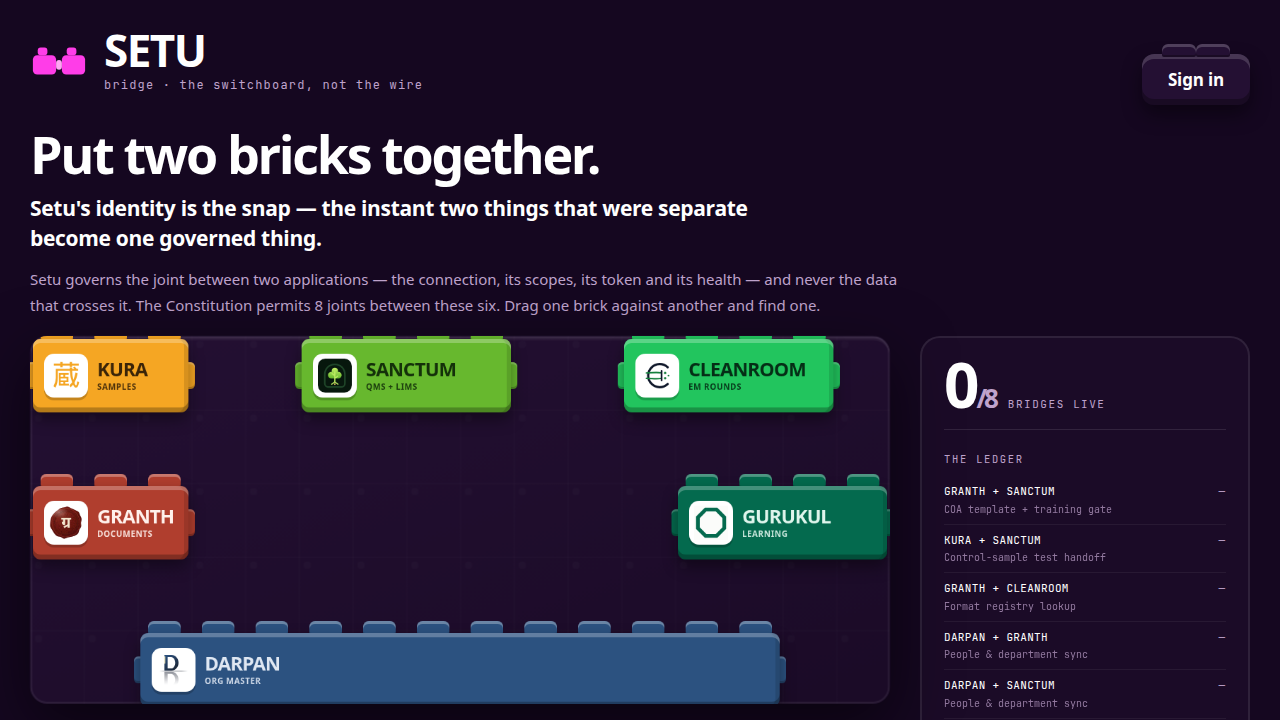
I picture it as a brick board. Put two bricks together, tick a few boxes, and a governed connection exists. A serious machine that feels like play.
I started in August twenty twenty-six, documentation first. The design is drawn, screen by screen. It is live, with every bridge still off, and the code is catching up. You are early.
Narrated in my own cloned voice, generated with ElevenLabs v4.
Setu means bridge. It doesn’t carry things. Across a pharma company’s family of internal applications, Setu decides who may bridge at all.
Think of it as the switchboard. When two applications need to connect, Setu authorises the connection, issues credentials, and keeps watch. The data always travels app to app. Setu never carries it. Its job is governance, not transit.
The metaphor for how it looks is bricks on a shared baseplate. Each application is a brick. Put two bricks together on the board, tick a few boxes, and a governed connection exists. A serious, regulated machine that feels like play.
The board, the handshake, the register, the credential issuer, and the health observation layer all exist. It’s live, but every bridge is still switched off. The full visual design is complete, drawn screen by screen, and the code is now being made to look and work as drawn. Switching on the first bridge comes after that.
I started in August 2026, documentation first, built with Claude Code.
The making
- TypeScript
- Next.js
- PostgreSQL
- Prisma