Back to the shelf

055

Sutra – TVC Building Management System

Sutra means the thread: every system in the new head office streaming into one living command centre.

Building · Started August 2026 · System · Notion-First

That's the whole thing.

The site's sound is off. The narration still plays.

This reading didn't load. The transcript is below.

Read the transcript

Sutra means thread. The name comes from Sutradhar, the narrator who holds the threads of a story together. A building has a story too. I wanted something that could tell it.

A new head office. Electrical, cooling, fire, plumbing, and IT, all streaming into one living, narrated portrait of the campus, in the browser. Built in-house, not bought. No lock-in to vendor hardware.

I set one rule: reading is ambient. Any control action is deliberate, and logged. Read-only comes first.

In August twenty twenty-six, I proved the first meter read. Since then, the foundation is done and the first two waves are built. A ten-chapter walkthrough of the building is online, running on recorded data that touches no real system.

Next comes the live pipeline, the floor plan, alerts, and one day, a 3D twin. Follow along.

Narrated in my own cloned voice, generated with ElevenLabs v4.
Sutra – TVC Building Management System
No. 055

Sutra means the thread. The name comes from Sutradhar, the narrator who holds the threads of a story together. This is the thread that holds the building’s story.

The building is a new company head office. It carries electrical systems, cooling and air, fire protection, plumbing, and an IT network. I wanted one place where all of that streams together: a living, narrated command centre in the browser. It’s built in-house, not bought, with no lock-in to proprietary vendor hardware.

The building should run on its own data, collected and presented its own way. Every monitored point is just that, a point. Reading is ambient. Any control action is deliberate and logged. Read-only comes first; anything that writes to the building comes later.

In August 2026, I proved the first step: live data reading from the building’s electricity meters. The visual direction is set too: a living portrait of the campus, with narration, a hardware tray, and module panels.

The path runs from concept studies through a point model, a live data pipeline, a floor-plan layer, limits and alerts, controlled actions, and eventually a 3D twin. This is the deepest learning build I’ve taken on: industrial protocols, time-series data, real-time visuals, and control systems in one project.

Started August 2026 with concept studies. It has moved into build since: the foundation is done, the first two waves are built, and a ten-chapter walkthrough of the building is online if you want to follow along.

The making

  • Vite
  • React
  • TypeScript

01 · The problem

Before it existed

What hurt

A new head office will run electrical, cooling, fire, plumbing and IT systems. No single screen shows the whole building, and the data should not be locked inside vendor software.

Who uses it

  • Engineering team on site
  • Facility operators
  • Engineers who sign limits
  • Technical leadership
  • 38commits in four days
  • 25build orders, 1 to 25
  • 9concept studies before the build
  • 6laws every screen must keep

02 · The flow

8 steps, in the order they happen

  1. 01 / 08

    Open the walkthrough

    You
    Opens the practice page
    It answers
    Says plainly that nothing here touches the building, then waits for Begin
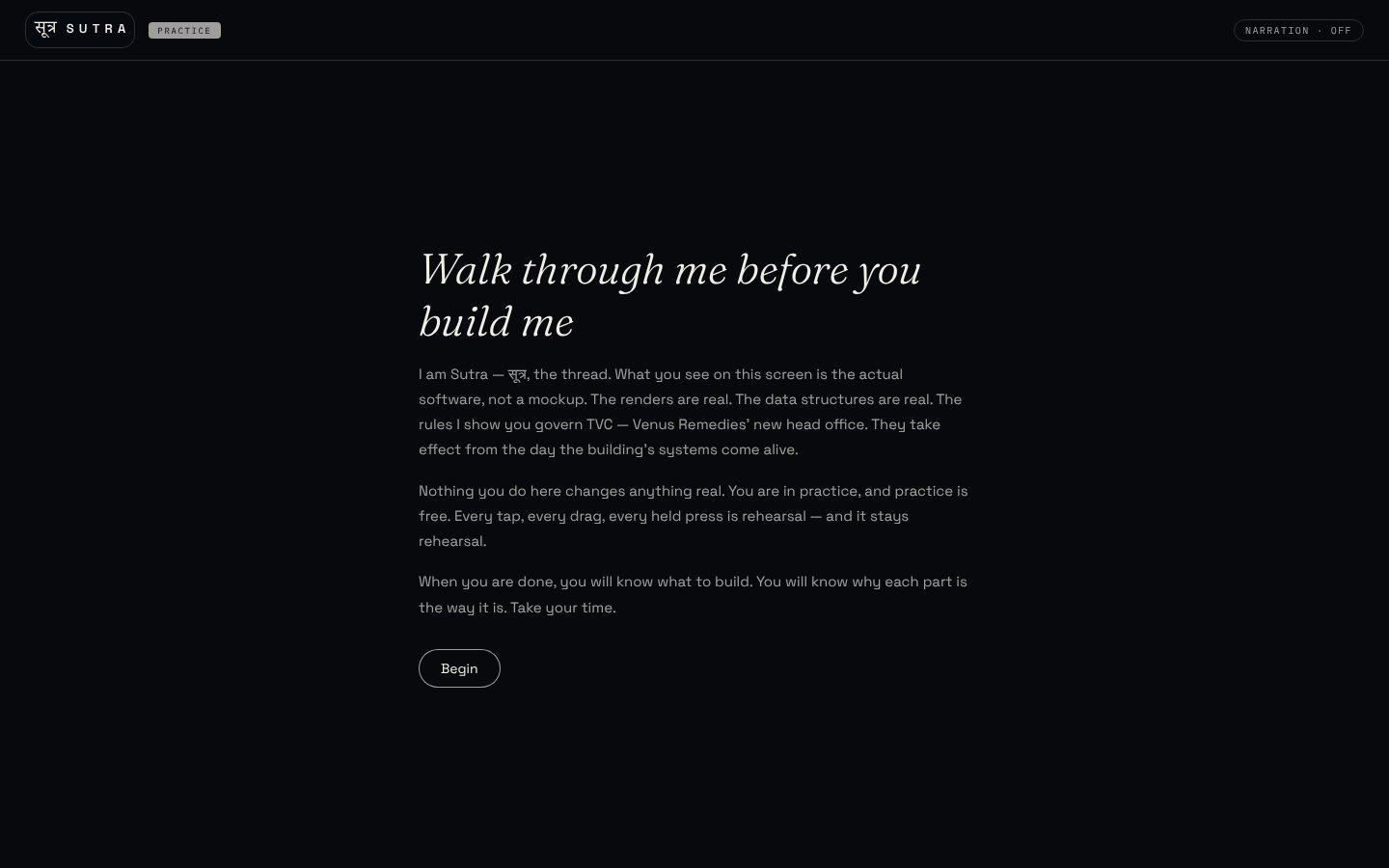
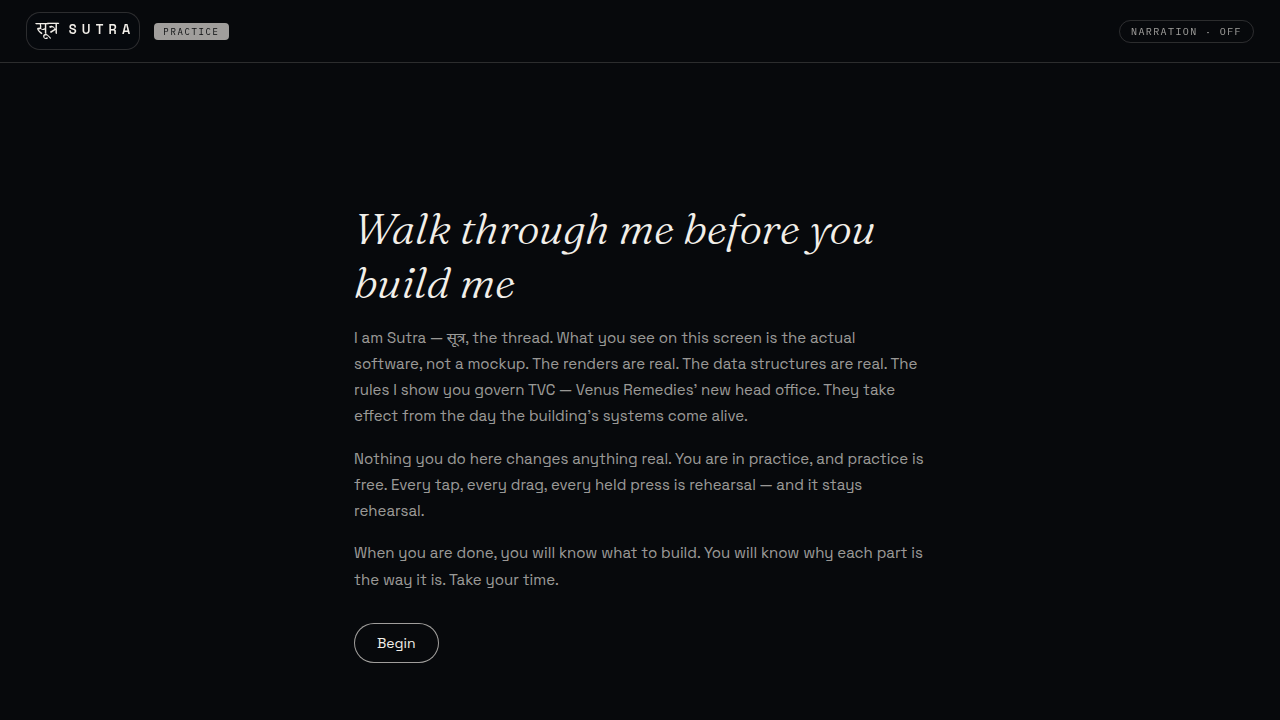
    Dark intro page: Walk through me before you build me, with a Begin button
  2. 02 / 08

    See the campus

    You
    Looks at the facade
    It answers
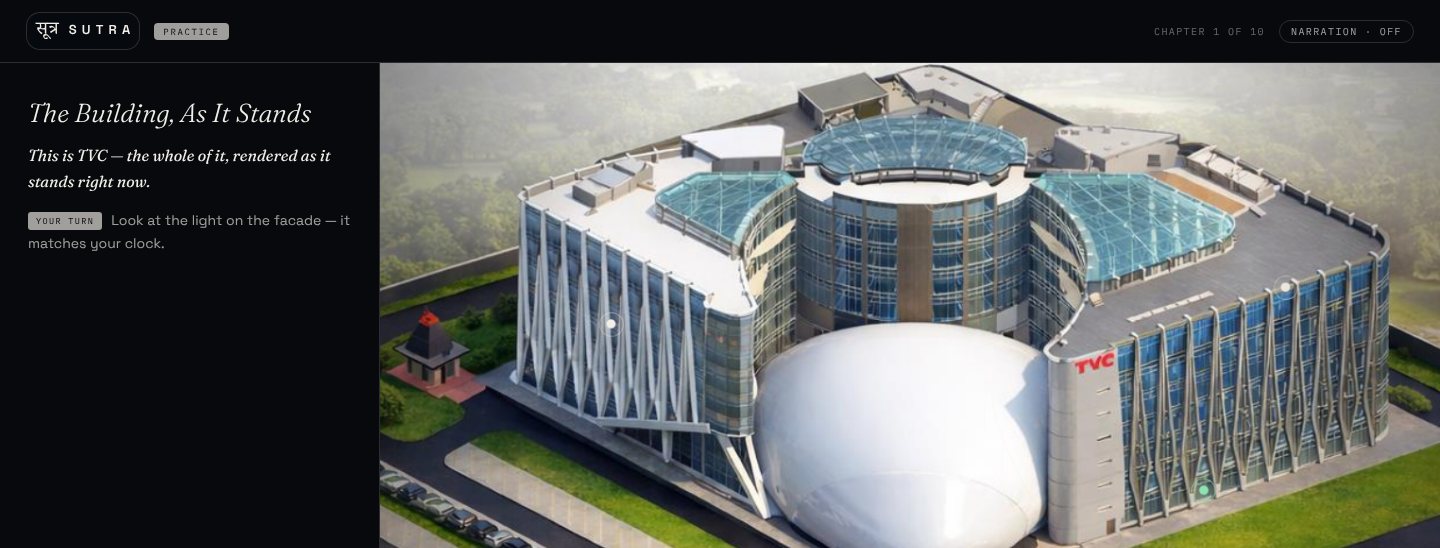
    Lights the whole campus render by the sun it stands under
    The campus render beside the first chapter, The Building, As It Stands
  3. 03 / 08

    Follow the six threads

    You
    Hovers a thread
    It answers
    Names the system and says whether a value is measured or simulated
  4. 04 / 08

    Open a panel

    You
    Clicks a monitor
    It answers
    Opens depth beside the building; the campus stays in view
  5. 05 / 08

    Move through time

    You
    Drags the scrubber back
    It answers
    Switches to review and keeps the exception column on the present
  6. 06 / 08

    Acknowledge an exception

    You
    Presses acknowledge
    It answers
    Clears the red and writes the acknowledgement to the log
  7. 07 / 08

    Ask for a change

    You
    Holds the control down
    It answers
    Asks for a name, then records the change in the ledger for good
  8. 08 / 08

    Read the registry

    You
    Opens a limit marked provisional
    It answers
    Draws the band but raises no alarm until an engineer has signed it

03 · What was special

What it stands on

  1. Every number shows its source

    Each value is tagged live, real or simulated. A simulated shape is never passed off as a measurement.

  2. Watching is free, changing costs a name

    Reading is ambient. Any change is held, confirmed and recorded permanently with the name of the person.

  3. A walkthrough before the build

    A ten-chapter guide runs the real components on recorded data, so a builder sees the rules before touching code.

A building that states its own condition – and never over-claims.

Making-Of

The building’s story, told by the building itself, from its own data.

The Notion brainstorm session and the first commit, the same day

  1. The world before

    The new head office should run on its own data, collected and presented its own way, with no lock-in to vendor hardware or connectors.

  2. One day

    3 August 2026. After a first meter read was proven, the brief: one living command centre in the browser for the whole campus, built in-house.

  3. Because of that

    1. Nine concept studies and a brand guideline settled the visual direction, the Bridge (3 Aug).
    2. Fourteen build orders landed in a day: design tokens, a point model, a replay of recorded data, the living campus shell, narration, panels and a time scrubber (3 Aug).
    3. A local server followed, with roles, an append-only ledger, an editable registry, alarms from signed limits and the write ritual (4 Aug).
    4. A one-command first run and a ten-chapter walkthrough made the build handoff-ready (4 Aug).
    5. The README was pointed at the walkthrough first, the code second (6 Aug).
  4. Until finally

    Phase 0 is complete and the first two waves are built. The walkthrough runs on recorded data and touches no real system.

  5. Since then

    Ahead: the live data pipeline, the floor-plan layer, limits and alerts, controlled actions and, last, a 3D twin.

The evidence Process, hands, and artifacts

Process

  1. Studies

    Nine concept studies on recorded data; the Bridge chosen

  2. Brand

    A written guideline and design tokens before any component

  3. Shell

    Everything is a point; the campus render is the floor of the app

  4. Memory

    Local-first server, roles and an append-only ledger

  5. Ritual

    Alarms only from signed limits; changes need a held press and a name

  6. Handoff

    One-command first run and a ten-chapter walkthrough

Hands

Akshansh

  • The brief, the six laws and the choice of the Bridge
  • Review of the brand and of the handoff

Agents

  • Claude CodeWrote most of the 38 commits
  • SpiralThe walkthrough script, in the building’s voice
  • ElevenLabsThe narration, recorded ahead of time