Back to the shelf

071

Swadarshan

An always-on channel inside the company, fed by a newsroom backend, carrying its archive and daily life to every screen.

Building · Started September 2026 · System · Notion-First

That's the whole thing.

The site's sound is off. The narration still plays.

This reading didn't load. The transcript is below.

Read the transcript

I was shaving one morning in September twenty twenty-six, recording a voice note, when the name arrived: Swadarshan. Self-vision. Doordarshan is India's national broadcaster. I took that formula and turned it inward, a company seeing itself.

The idea: a media company inside the company. A channel, always on, fed by a newsroom backend, carrying the organisation's archive and its daily life to a dedicated screen at the head office, to the web, to the phone. Other departments were getting purpose-built software. The programming already existed, scattered in fragments. The media team deserved the same.

A demo is live, with sample data. The team is getting sign-in next, ahead of a pilot, and the launch is aimed at twenty twenty-seven. Follow along and watch it develop.

Narrated in my own cloned voice, generated with ElevenLabs v4.

I was shaving on the morning of 17 September 2026 when the idea arrived, and I recorded it as a voice note. By the end of that day, it had a name: Swadarshan.

Swadarshan means self-vision. The name reapplies the formula of Doordarshan, India’s national broadcaster, and turns it inward. This is the company seeing itself.

The idea is to run the in-house design and media team as a media company inside the company. A channel, always on. A newsroom backend behind it. It carries the organisation’s daily life and its decades-long archive to a dedicated screen at the new head office, to the web, and to the phone. Other departments were getting purpose-built software. The programming already exists in fragments. The media team’s digitisation deserves the same ambition.

Swadarshan has its own brand kit and identity. Production tasks and approvals stay in the team’s existing task tool. Swadarshan is the identity, the viewing side, and the on-air desk.

A demo is live with sample data. The team is being given access now: staff sign-in first, then the ability to back a story, which is a signal, never an approval. A pilot follows. The launch target is 2027. It isn’t production-ready yet, but you can follow along from here.
01 · The problem

Before it existed

What hurt

Screens across the head office displayed whatever someone had last loaded by hand. Nobody could say what was on which TV, or switch every screen at once.

Who uses it

  • Media team operators
  • Desk administrators
  • Staff walking past a screen
  • 119commits in two months
  • 47pull requests
  • 7channel templates
  • 9rooms in the Desk

02 · The flow

7 steps, in the order they happen

  1. 01 / 07

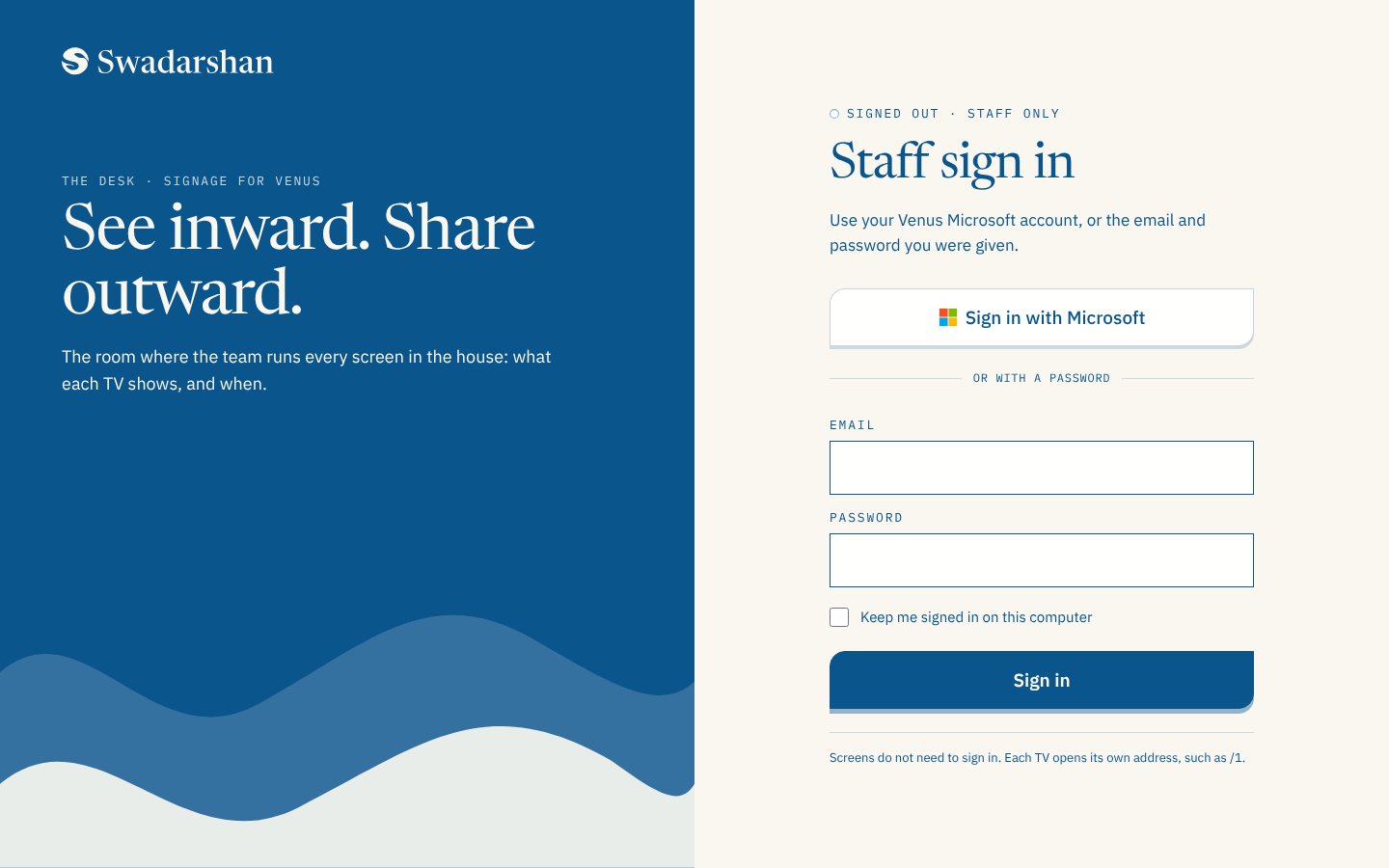
    Sign in to the Desk

    You
    Opens the staff sign-in
    It answers
    Lets in Venus accounts, or a password where one is switched on
    Staff sign in page with a Microsoft button and a password form
  2. 02 / 07

    Read the overview

    You
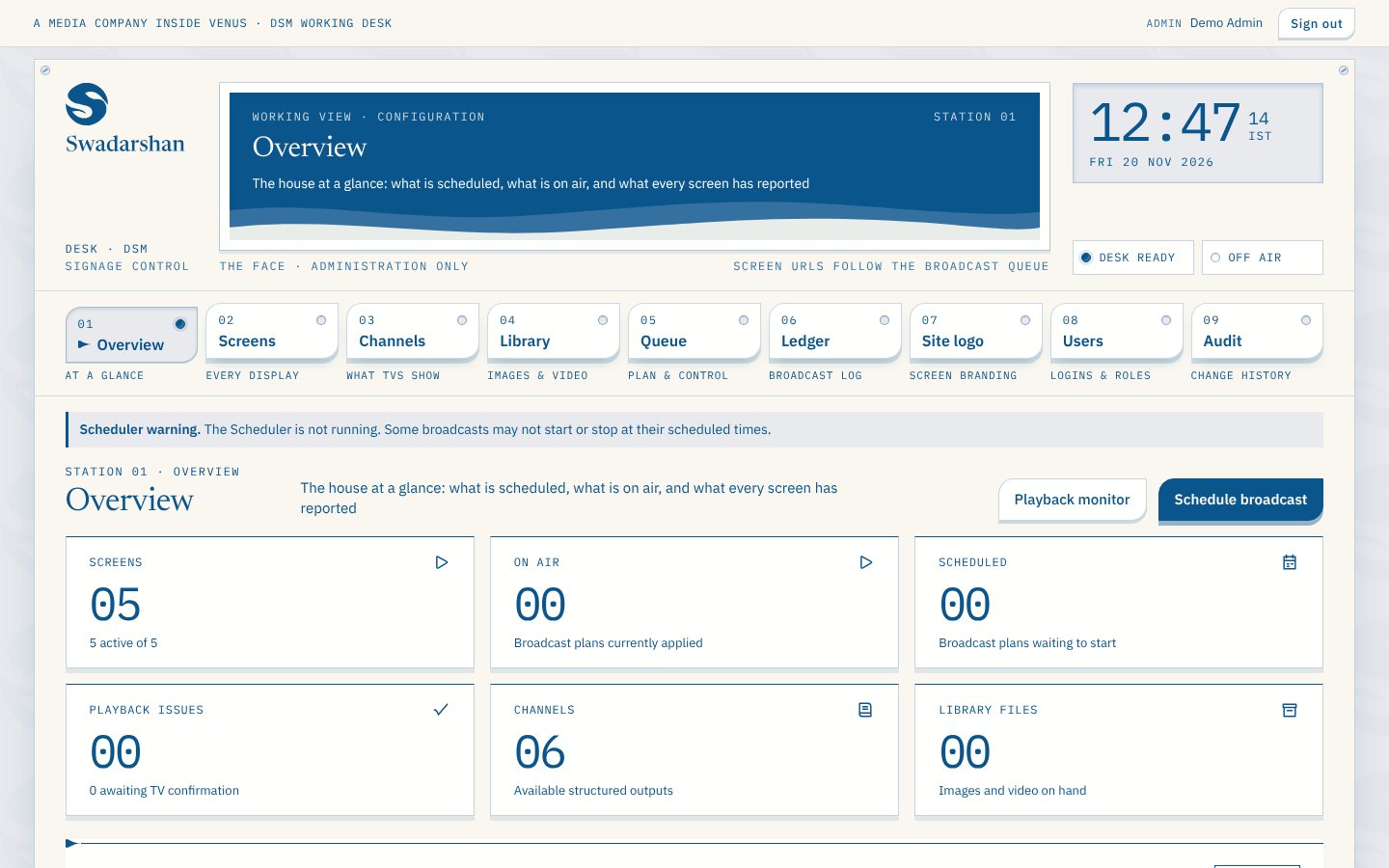
    Lands on the Desk
    It answers
    Shows what is scheduled, what is on air and what every screen reported
    Desk overview with counts for screens, on air, scheduled and channels
  3. 03 / 07

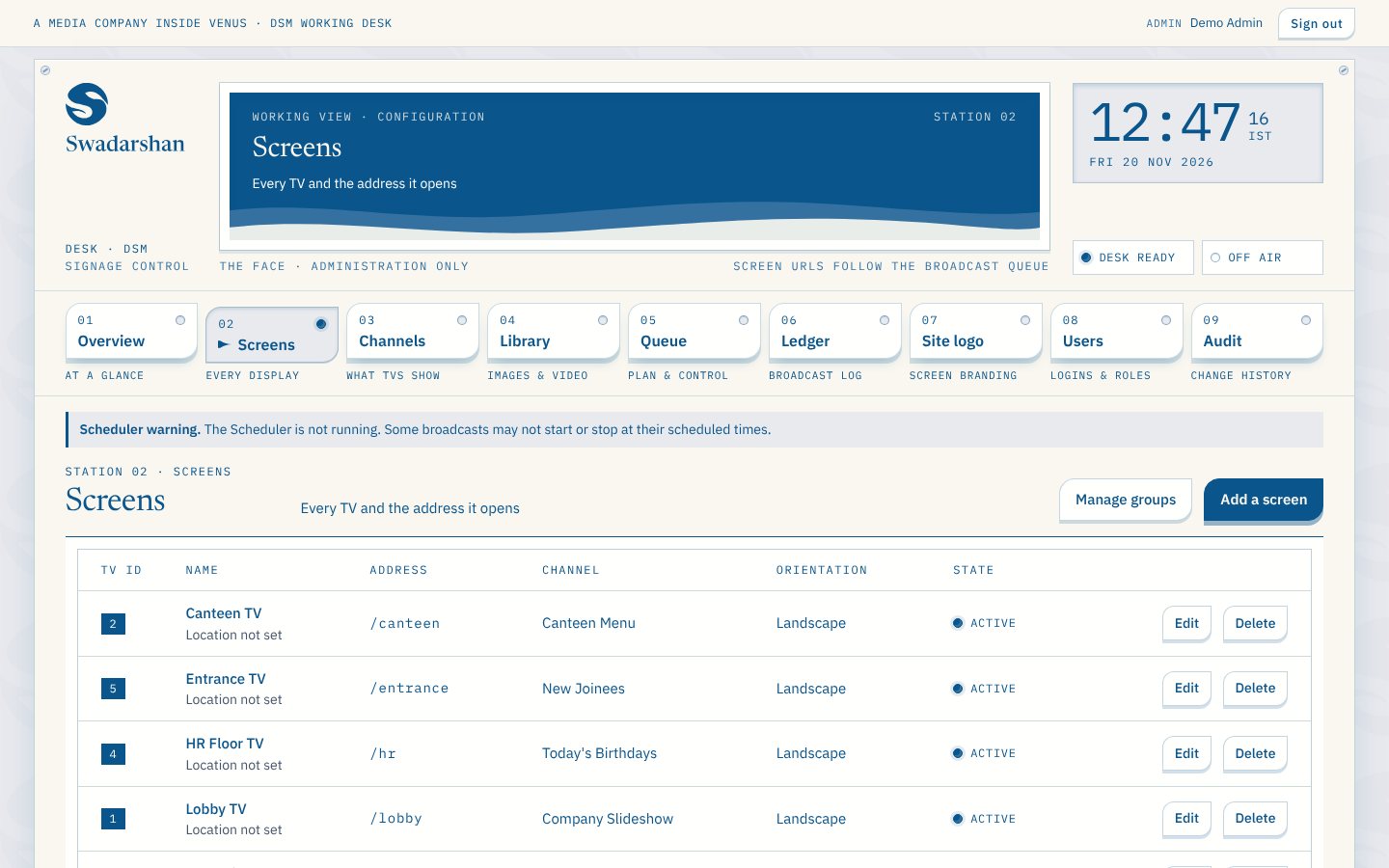
    List every screen

    You
    Opens Screens
    It answers
    Gives each TV a short address and an assigned channel
    Table of five screens with addresses and channels
  4. 04 / 07

    Choose what TVs show

    You
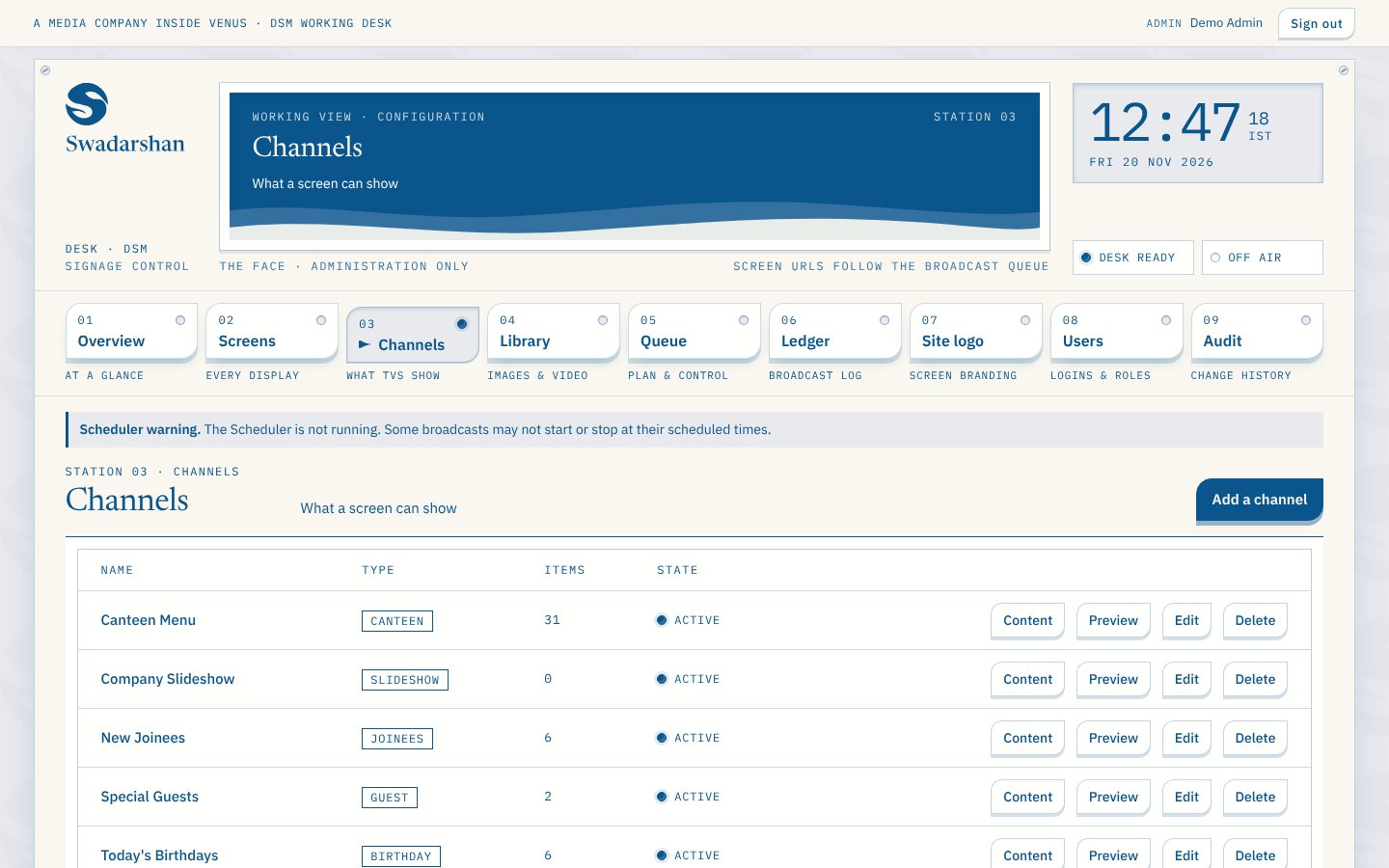
    Opens Channels
    It answers
    Offers seven fixed templates, each with its own ordered content
    Channels list: canteen, slideshow, joinees, guests and birthdays
  5. 05 / 07

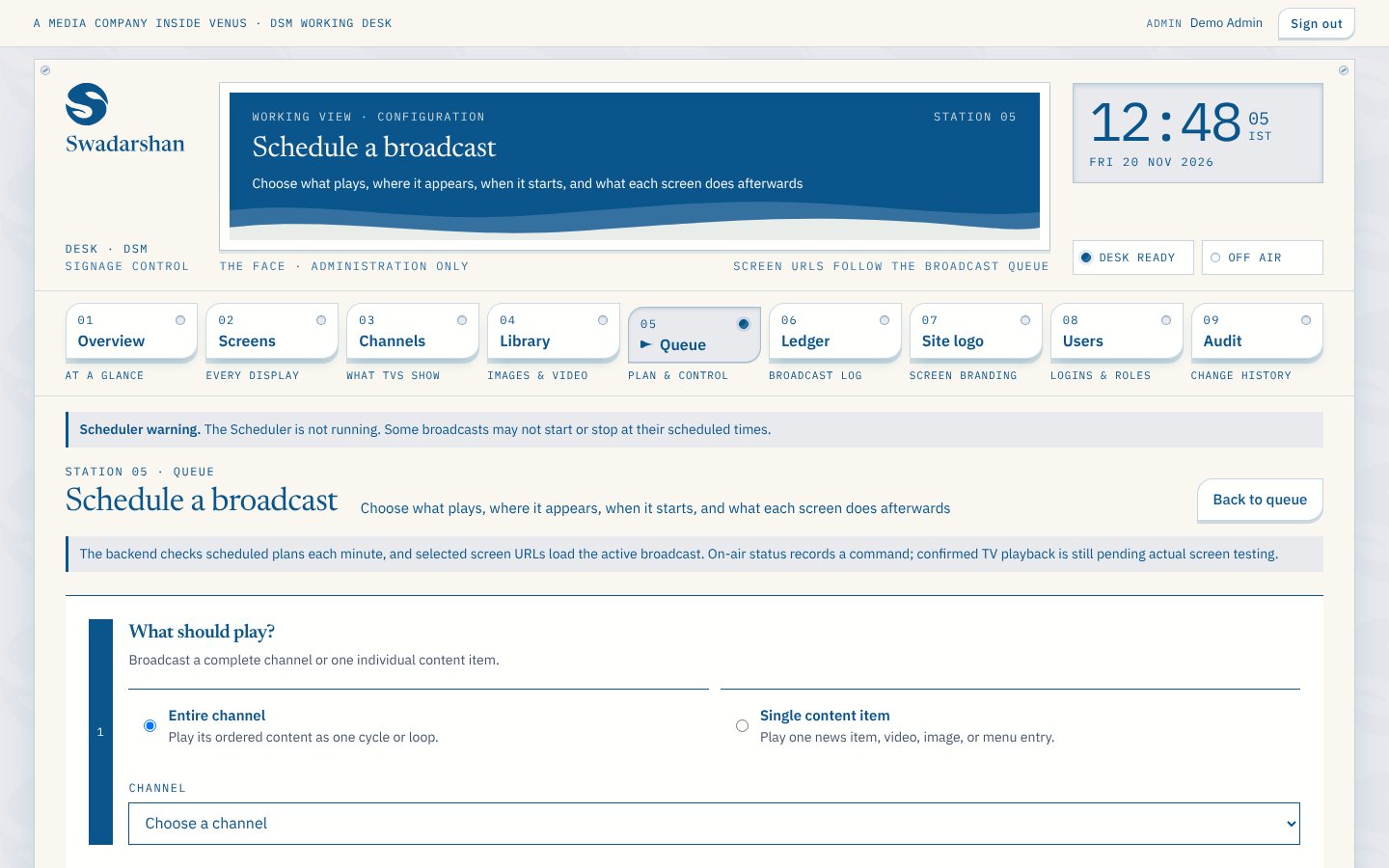
    Schedule a broadcast

    You
    Picks a channel or one item, screens and a start
    It answers
    Checks for conflicts, then queues it for each chosen screen
    Schedule a broadcast form starting with what should play
  6. 06 / 07

    See it on the TV

    You
    Walks past the screen
    It answers
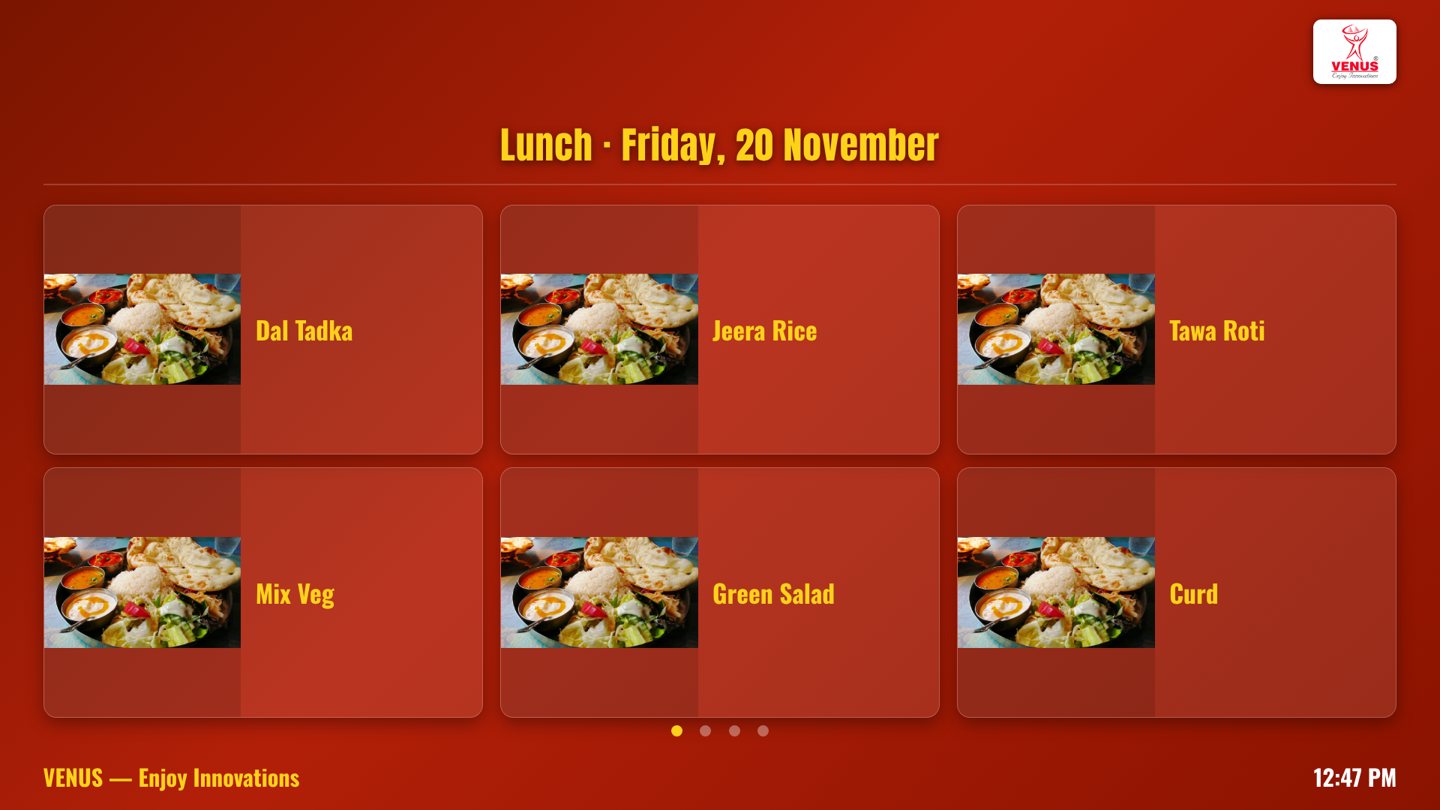
    Plays the assigned channel, or the active broadcast over it
    A canteen menu channel on a 1080p screen
  7. 07 / 07

    Keep the ledger

    You
    Opens the broadcast ledger
    It answers
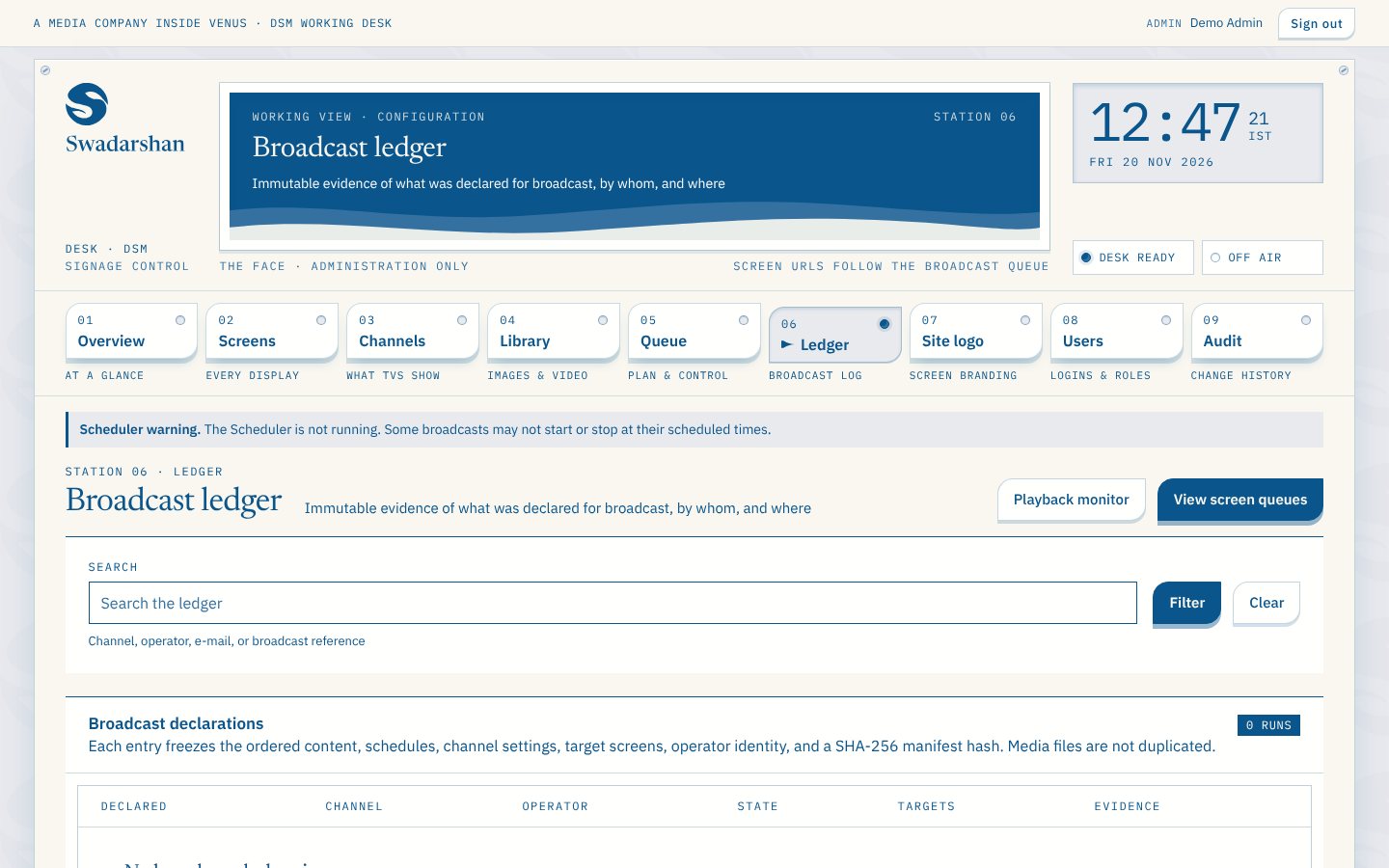
    Freezes who declared what, where, with a hash of the manifest
    Broadcast ledger with search and a declarations table

03 · What was special

What it stands on

  1. A channel, not a slideshow

    Fixed templates for news, menu, birthdays, and guests keep every screen on brand without per-screen design work.

  2. A brand drawn first

    A full identity – mark, book, templates, and a brand check that returns zero findings – exists beside the app.

  3. Honest about proof

    On air records a command. The product states plainly that it does not prove what a TV displayed.

One desk runs every screen in the house.

Making-Of

A company that sees itself: one channel, one desk, every screen.

A voice note and the name, the same day

  1. The world before

    Screens at the plant carried whatever had last been loaded by hand, and the media team’s programming lived in fragments.

  2. One day

    17 September 2026. A voice note, and a name that turned Doordarshan inward: Swadarshan, self-vision.

  3. Because of that

    1. The brand law and a demo of the viewing side went up on Railway (22 Sep).
    2. The team-access phase opened: staff sign-in, then story voting as a signal, never an approval (24 Sep).
    3. The repository took on a Laravel signage app for running every TV from one desk (26 Oct).
    4. Identity 1.0 arrived with a brand book, templates and a brand check (31 Oct), polished in 1.1 (4 Nov).
    5. Two QA rounds closed 30 defects, and a screen app for the wall TVs was added (14–20 Nov).
  4. Until finally

    The signage app is in QA with a baseline specification. The identity kit stands at 1.1.1.

  5. Since then

    Still owed: a real TV check of the on-air bug, verified playback events and the 2027 launch.

The evidence Process, hands, and artifacts

Process

  1. Name

    Swadarshan – a media company inside the company

  2. Demo

    Live on Railway with sample data

  3. Access

    Staff sign-in; ClickUp keeps approvals by hand

  4. Signage

    A Laravel desk for every screen, built by a Spine teammate

  5. Identity

    Living Disc and Great Wave brand, book and templates

  6. Polish

    Identity 1.1 and seven signage channel designs

  7. Release

    Kit 1.1.1 and the channel bug as a disc on a plate

  8. QA

    Baseline specification after two QA rounds

Hands

Akshansh

  • The name, the metaphor and every brand ruling
  • Direction of the signage app and its scope
  • Review of the identity before release

Agents

  • Claude CodeBuilt the identity and much of the application
  • CursorExecuted written briefs