Back to the shelf

036

The Table

A private archive of five years of management meetings, built so institutional knowledge doesn't disappear.

Launched · Started March 2026 · Web App · Vibe-Coded

That's the whole thing.

The site's sound is off. The narration still plays.

This reading didn't load. The transcript is below.

Read the transcript

Management meetings carry enormous institutional knowledge. And then the meeting ends. Most of it disappears into forgotten threads, into minutes nobody reads.

I started The Table to change that. It is a private, password-protected archive of management meetings at a pharma company, spanning five years, from twenty twenty to twenty twenty-six. Every entry captures the agenda, the decisions, and the context. A leader can trace how a decision evolved. A new leader can read the arc and get context, not folklore.

I designed it to feel like a place, not a dashboard. It is intentionally restrained, like opening a book.

It's launched, and it's private, so you cannot log in. If this kind of thinking interests you, I am glad you are here.

Narrated in my own cloned voice, generated with ElevenLabs v4.

Management meetings carry enormous institutional knowledge. Then the meeting ends. Most of it disappears into forgotten threads and unread minutes.

The Table is a private, password-protected web archive of the management meetings at Venus Remedies, a pharma company I work with. It holds ninety-nine meetings from October 2020 onward, six years of leadership decisions, captured in one place.

I built it because that knowledge matters too much to let it evaporate. When you’re in the room, the context is obvious. Later, a new leader asks why a call was made, and the answer is folklore at best. The Table keeps the arc visible. Each entry holds the agenda, the decisions, and the context around them. You can search and filter across the whole archive, and trace how a decision evolved.

I wanted it to feel like a place, not a dashboard. The design is intentionally restrained: opening it should feel like opening a book, not logging into a tracker.

It’s vibe-coded with AI, built in HTML, JavaScript, and Node.js. I started in March 2026. It’s launched and it’s private, so there’s no link here, just this page.

The making

  • HTML
  • JavaScript
  • Node.js

01 · The problem

Before it existed

What hurt

Years of management decisions lived in PDF minutes, inboxes, and memory. A new leader inherited the decisions without the reasoning behind them.

Who uses it

  • Senior management
  • Future leadership
  • 99meetings on record
  • 41commits
  • 3documented gaps, never filled in

02 · The flow

6 steps, in the order they happen

  1. 01 / 06

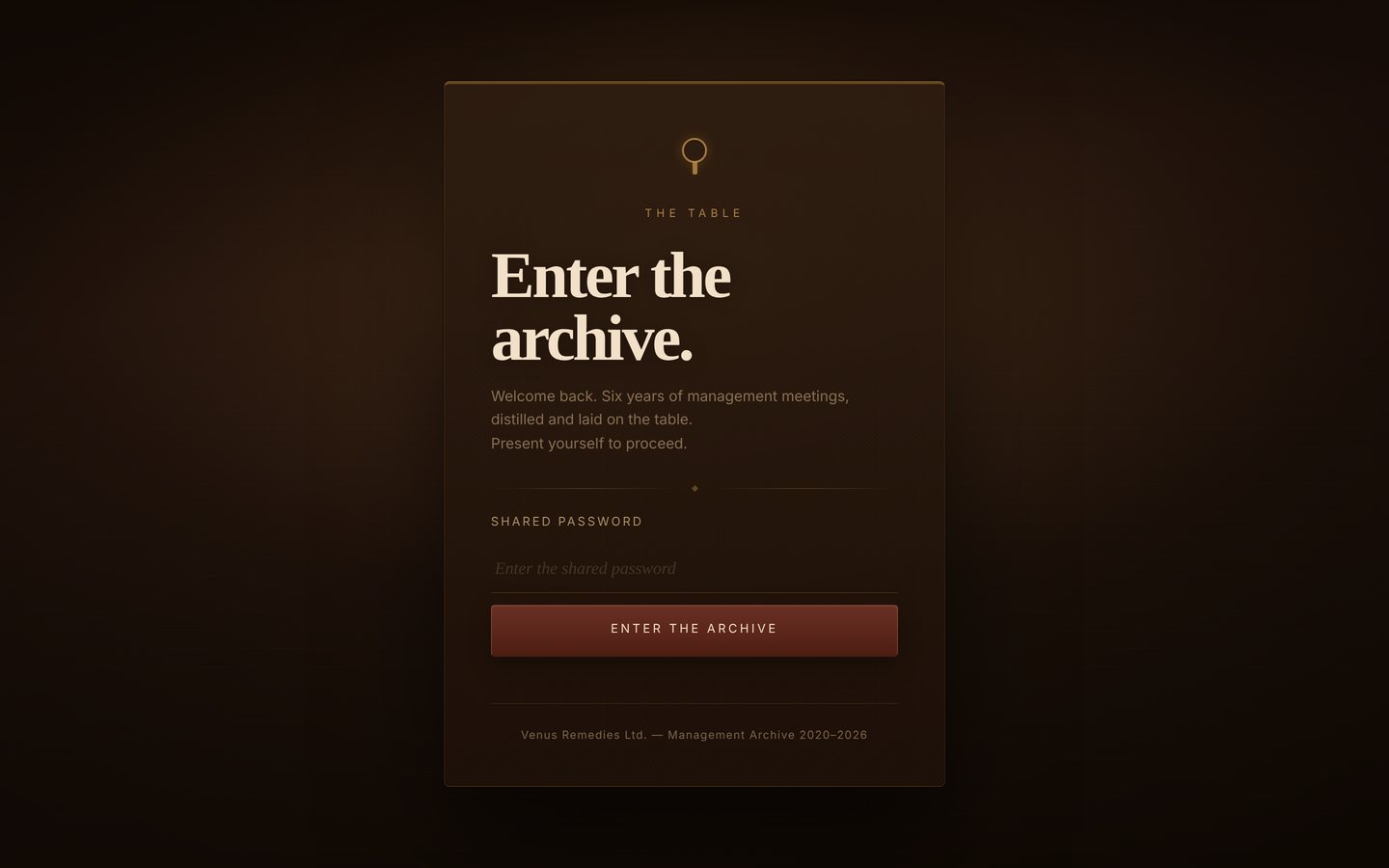
    Enter the archive

    You
    Types the shared password
    It answers
    Opens a session; the keyhole catches the lamp and turns a quarter
    A mahogany login card with a brass keyhole and the words Enter the archive
  2. 02 / 06

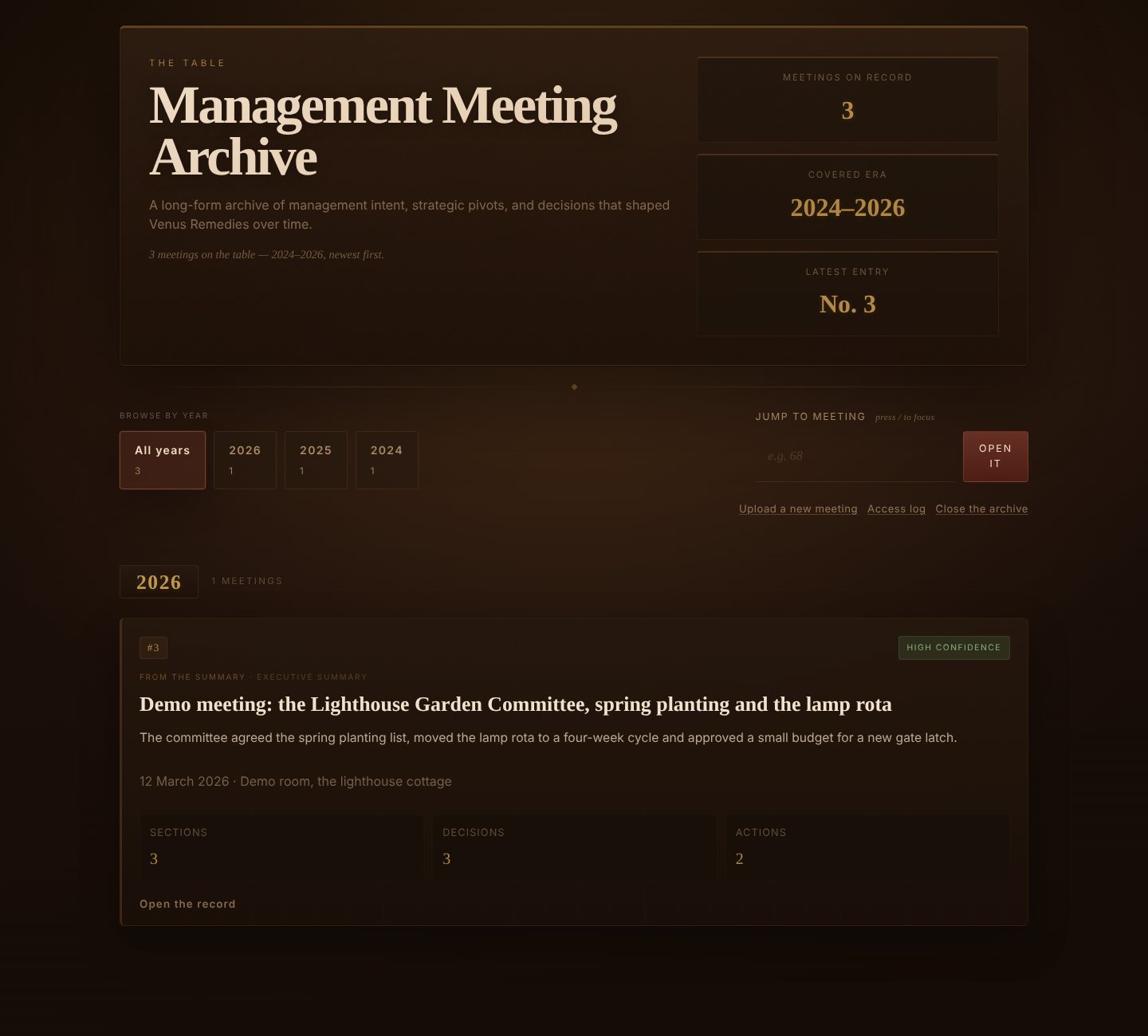
    Browse by year

    You
    Picks a year or jumps to a meeting number
    It answers
    Lists meetings with a summary, counts and an extraction-confidence mark
    The archive index of an invented demo meeting with year filters and counts
  3. 03 / 06

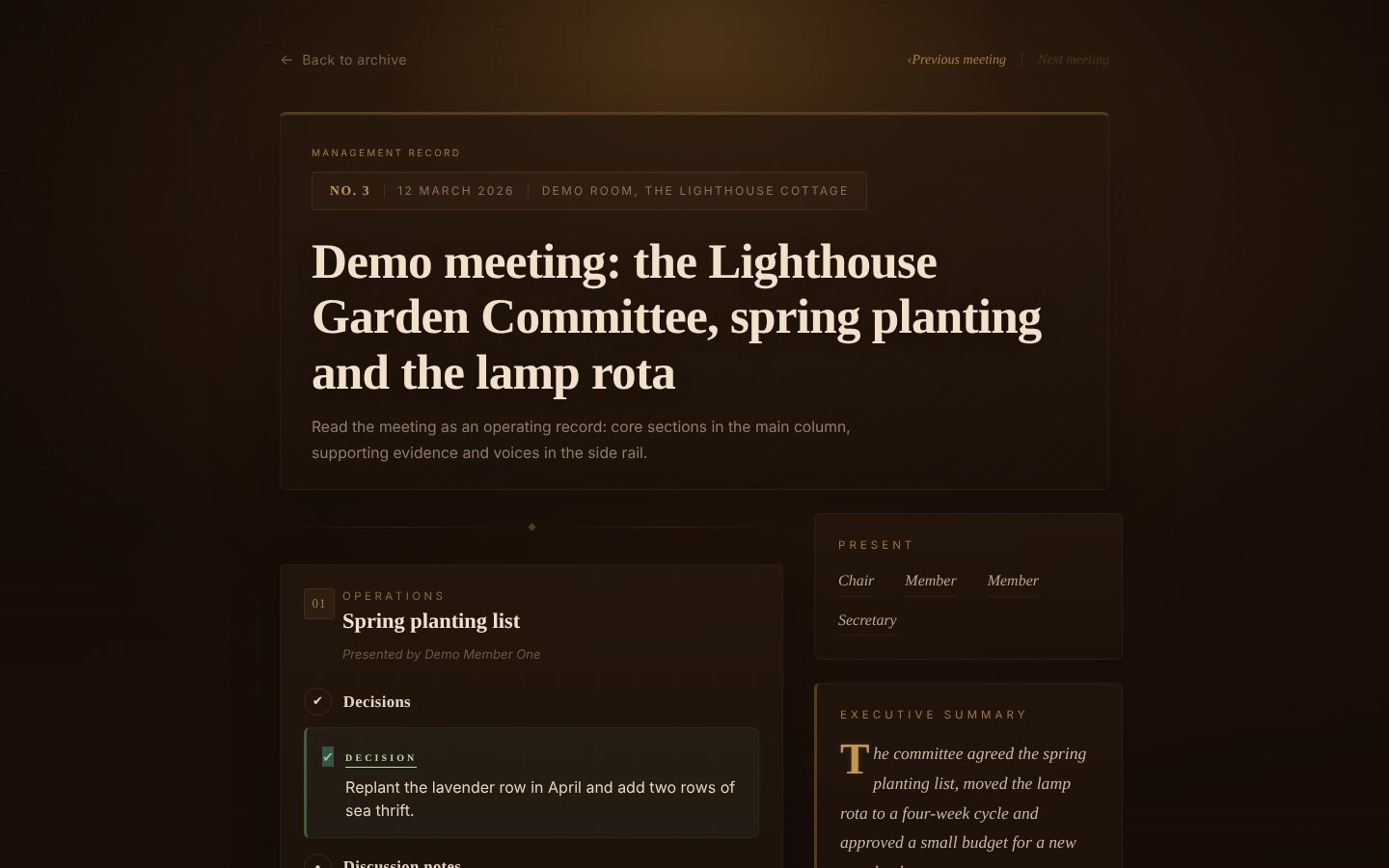
    Read a record

    You
    Reads the chapters of one meeting
    It answers
    Groups decisions, actions, figures and quotes beside the attendees
    A demo meeting record with a decision card and an attendee and summary rail
  4. 04 / 06

    Turn the page

    You
    Presses a bracket key
    It answers
    Moves to the previous or next meeting, like a book
  5. 05 / 06

    Add one meeting

    You
    Uploads the structured minutes and reviews a preview
    It answers
    Checks them against a schema and writes one meeting, not a re-import
  6. 06 / 06

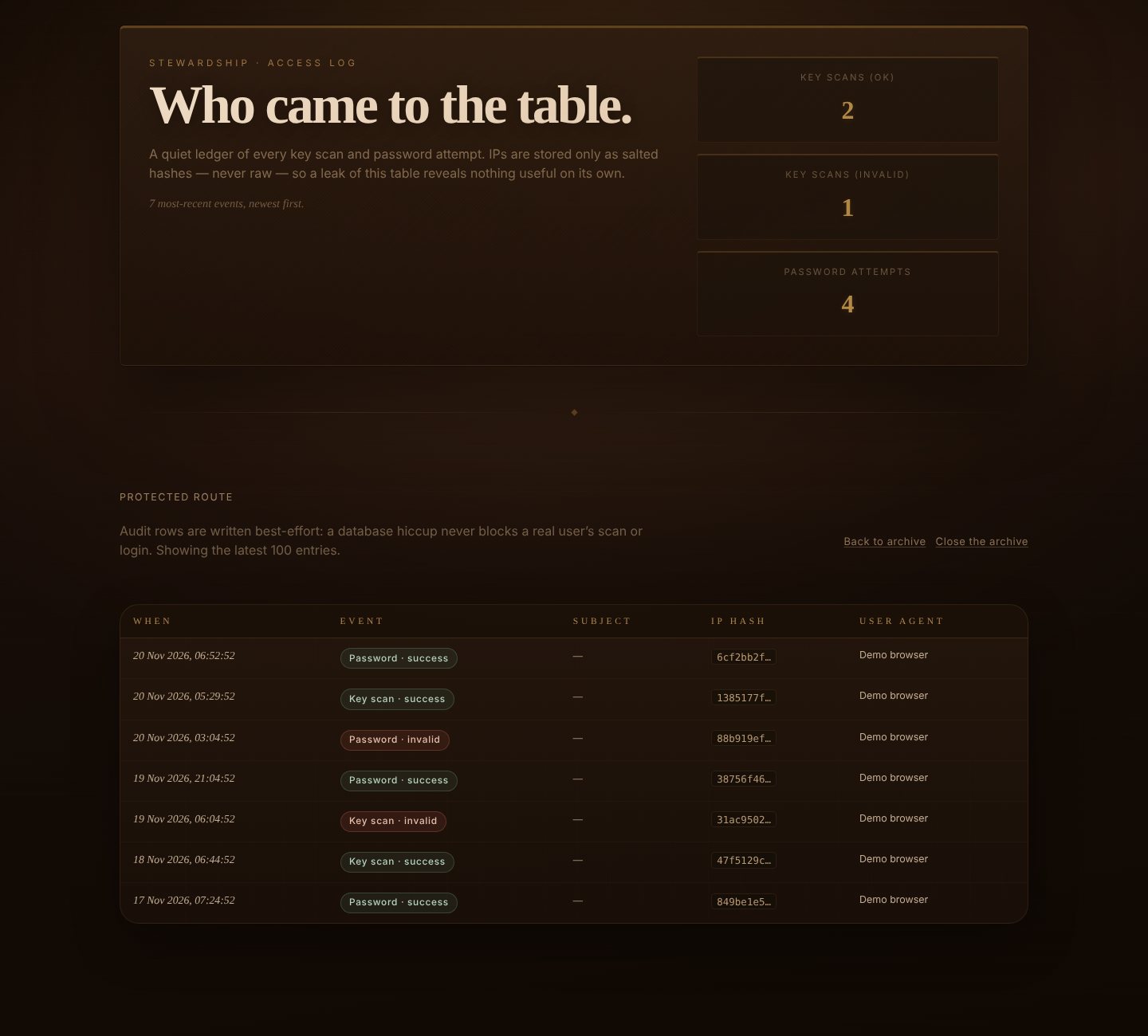
    Check who came

    You
    Opens the access log
    It answers
    Lists every entry and failed attempt, with addresses stored only as salted hashes
    The access log with counts of successful and invalid entries and a table of events

03 · What was special

What it stands on

  1. A boardroom at night

    Mahogany, serif headlines and one brass lamp. The repo’s own rule: if it starts to feel like a ticket tool, it is wrong.

  2. Keys of a book

    A slash jumps to a meeting number; bracket keys turn the pages. No icons, no coloured pills.

  3. Honest gaps

    Each extraction carries a confidence mark. Missing meetings are documented as missing – never invented.

An archive built as a room, not a dashboard.

Making-Of

Years of decisions, and the reasons behind them, in a room that looks like a boardroom library at night.

Notion brainstorm entry of 27 March 2026; the first commit followed on 28 March

  1. The world before

    Management meetings at the pharma company I work with produced years of institutional knowledge that lived in PDF minutes, inboxes and individual memory. A new leader inherited decisions without the reasoning that produced them.

  2. One day

    27 March 2026. The brief: a password-protected archive that feels like a place, not a dashboard, with decisions, discussions and strategy searchable across the years. The design north star: build places, not products.

  3. Because of that

    1. Every set of minutes was extracted from PDF into structured JSON against a schema, each with a confidence mark (28 March).
    2. A Next.js and PostgreSQL app went live on Railway the next day, with an admin upload flow and a JSON fallback for local work (28 March).
    3. The look was fixed by a metaphor: a boardroom library at night, lit by one brass desk lamp (28 to 29 March).
    4. A C.L.E.A.R. design pass and an ALIVE interaction pass added card tilt, slash and bracket keys, and staggered reveals (29 March).
    5. A Build, Style, Move, Write audit ran before a senior leader first opened it (30 April).
    6. New meetings now go through a written, repeatable minutes-to-archive procedure with a source-coverage check (15 November).
  4. Until finally

    The Table is live and private. Notion records 99 meetings, from October 2020 to October 2026, with three documented gaps.

  5. Since then

    The archive grows one meeting at a time, each verified against its source document before and after publication.

The evidence Process, hands, and artifacts

Process

  1. Origin

    A private archive of management meetings that feels like a place

  2. Build

    Extract all minutes to validated JSON; ship app, database and admin upload

  3. Design

    Boardroom Library art direction; C.L.E.A.R. and ALIVE passes

  4. Readiness

    Pre-launch Build, Style, Move, Write audit; 24 polish items shipped

  5. Mobile

    Nine mobile tasks written as a doer and checker list for an AI executor

  6. Milestone

    Meeting number 100 added

  7. Workflow

    Repeatable minutes-to-archive workflow with source-coverage checks

Hands

Akshansh

  • Concept and the place-not-a-dashboard standard
  • Curation: which meetings, what counts as a gap, what is verified
  • Design direction and every publication decision

Agents

  • Claude CodeLead: wrote the plan, extracted the minutes, built the app, checked executor work
  • AmpExecutor for the mobile-readiness tasks and later builds