Back to the shelf

013

Vision Espine

Seven clickable prototypes that turn a proposed digital transformation into something decision-makers can explore and react to.

Launched · Started August 2025 · Prototype · Vibe-Coded

That's the whole thing.

The site's sound is off. The narration still plays.

This reading didn't load. The transcript is below.

Read the transcript

A slide deck can describe a transformation. It cannot let you feel one. That was the problem I kept running into, and it was the reason I built Vision Espine.

Seven interconnected web prototypes for Venus Remedies and Spine Software. Each one clickable, each self-contained, all part of one narrative: an academy for learning, bridges for cross-functional connections, a foundation layer, an intelligence layer called Luna, a playground for experimentation, and a vision module for strategic alignment.

I built them in HTML, CSS and JavaScript, to my CLEAR review framework, vibe-coded with AI. Started August twenty twenty-five. Launched.

Strategy becomes real when you can click through it.

Narrated in my own cloned voice, generated with ElevenLabs v4.

A slide deck can’t let you feel a transformation. It can describe a proposed system, outline the logic, show the roadmap, but it can’t put the thing in your hands.

Vision Espine is my answer to that. I built it for Venus Remedies and Spine Software: a suite of seven interconnected, clickable web prototypes that together paint a picture of a proposed digital transformation. Each is self-contained. Together, they tell one narrative that decision-makers can click through and react to.

The seven modules cover a vision for strategic alignment, a foundation layer for core systems, bridges for cross-functional connections, an intelligence layer called Luna, a playground for experimentation, an academy for learning, and a later revision of the vision. Every one is built to be explored, not just shown.

The shift from strategy in slides to strategy you can try is the whole point. Abstract becomes tangible. A proposal becomes a prototype.

I built it in HTML, CSS, and JavaScript, vibe-coded with AI, to my CLEAR review framework. I started in August 2025. It’s launched.

The making

  • HTML
  • CSS
  • JavaScript

01 · The problem

Before it existed

What hurt

A slide deck can describe a proposed digital transformation but cannot let decision-makers try it. Reactions stay abstract.

Who uses it

  • Decision-makers at Venus and Spine
  • Team leads
  • 7clickable prototypes
  • 3bridge demonstrations
  • 3commits, all in one day

02 · The flow

6 steps, in the order they happen

  1. 01 / 06

    Open the overview

    You
    Opens the overview
    It answers
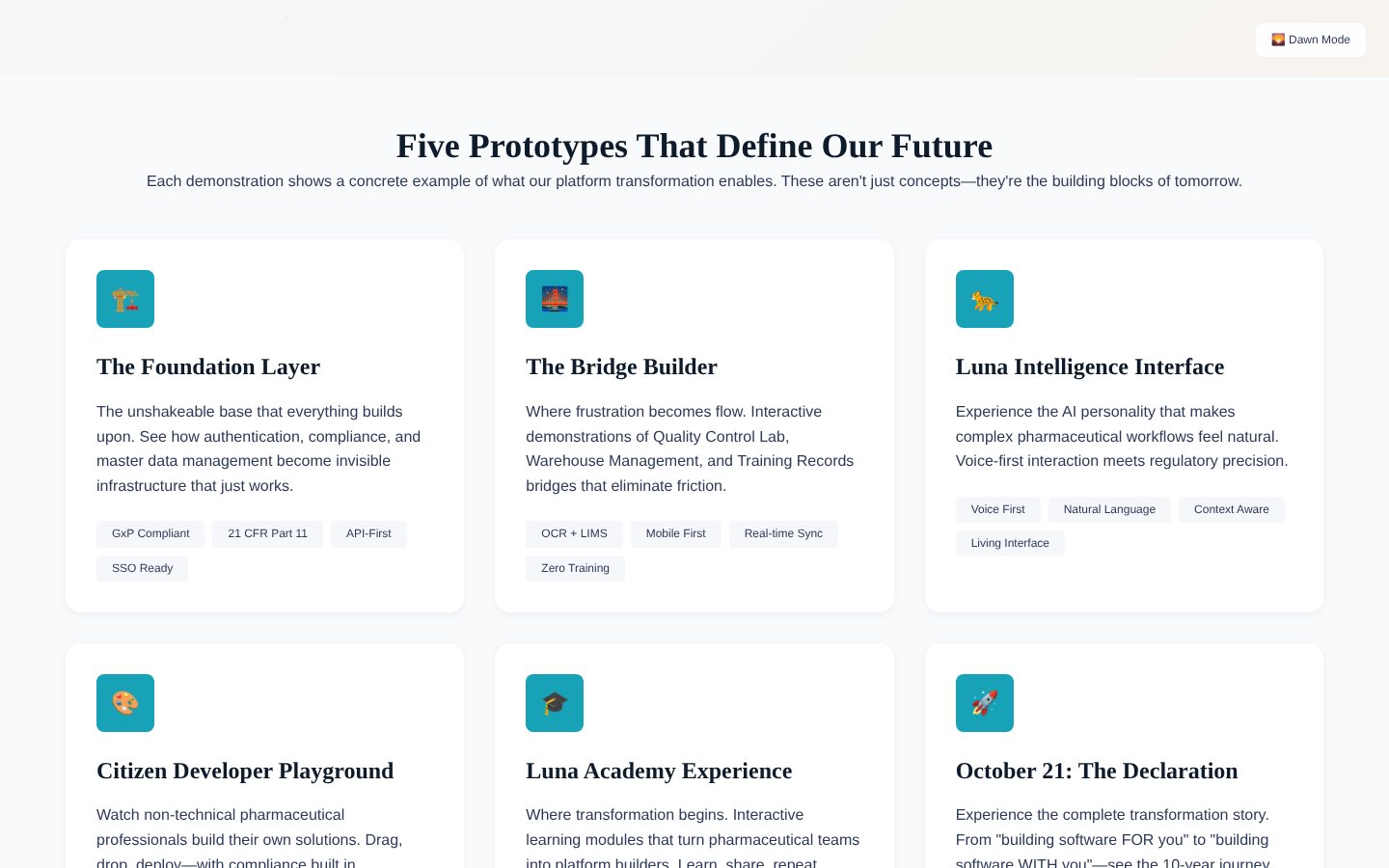
    Lists the prototypes as cards, with a dawn to night colour mode
    The overview grid of prototype cards: foundation, bridge builder, intelligence layer, playground, academy, declaration
  2. 02 / 06

    See the problem

    You
    Reads the foundation layer
    It answers
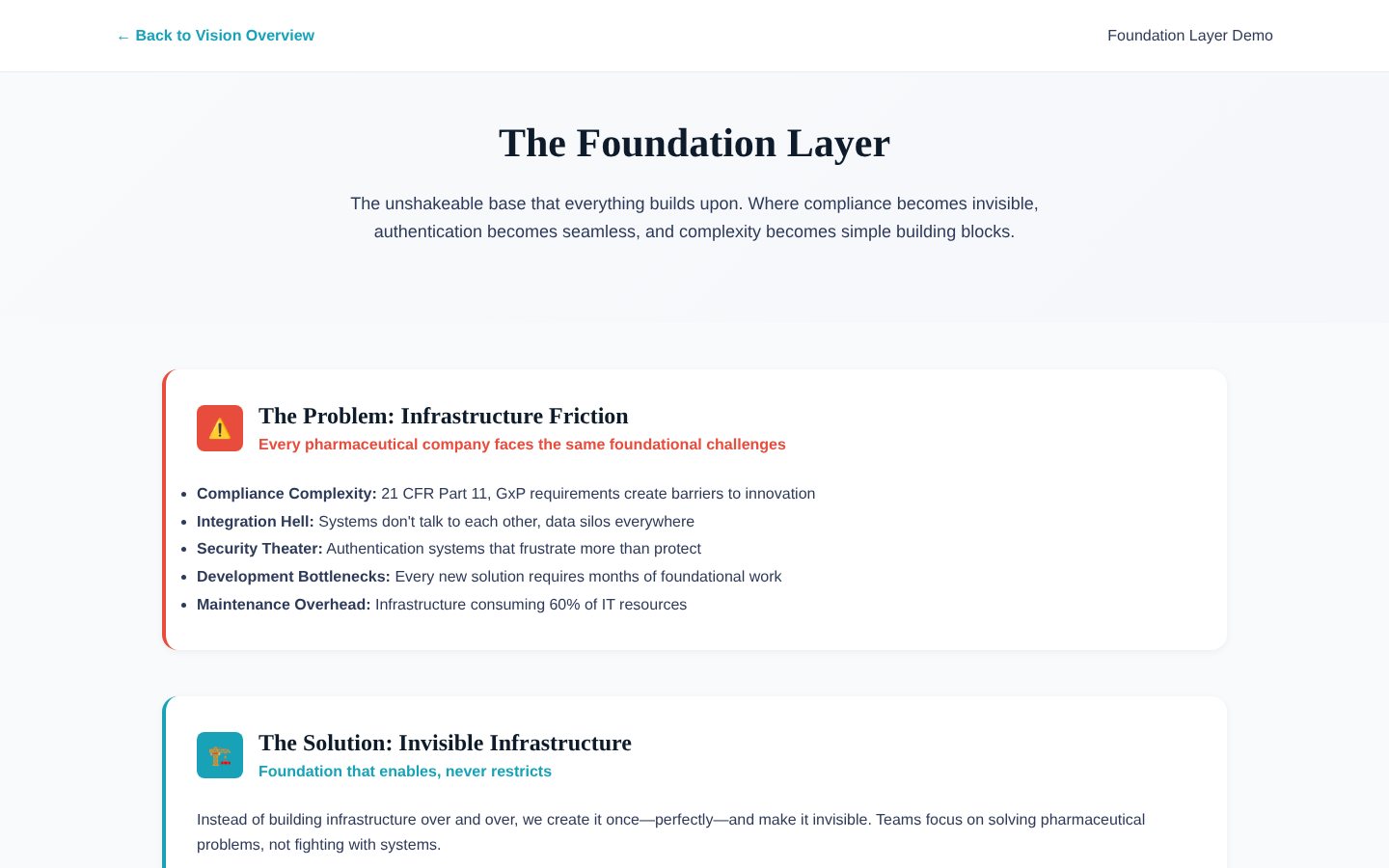
    Sets today’s friction against the proposed base, then lets you click through the stack
    The Foundation Layer page with a problem card and a solution card
  3. 03 / 06

    Try a bridge

    You
    Picks QC lab, warehouse or training records
    It answers
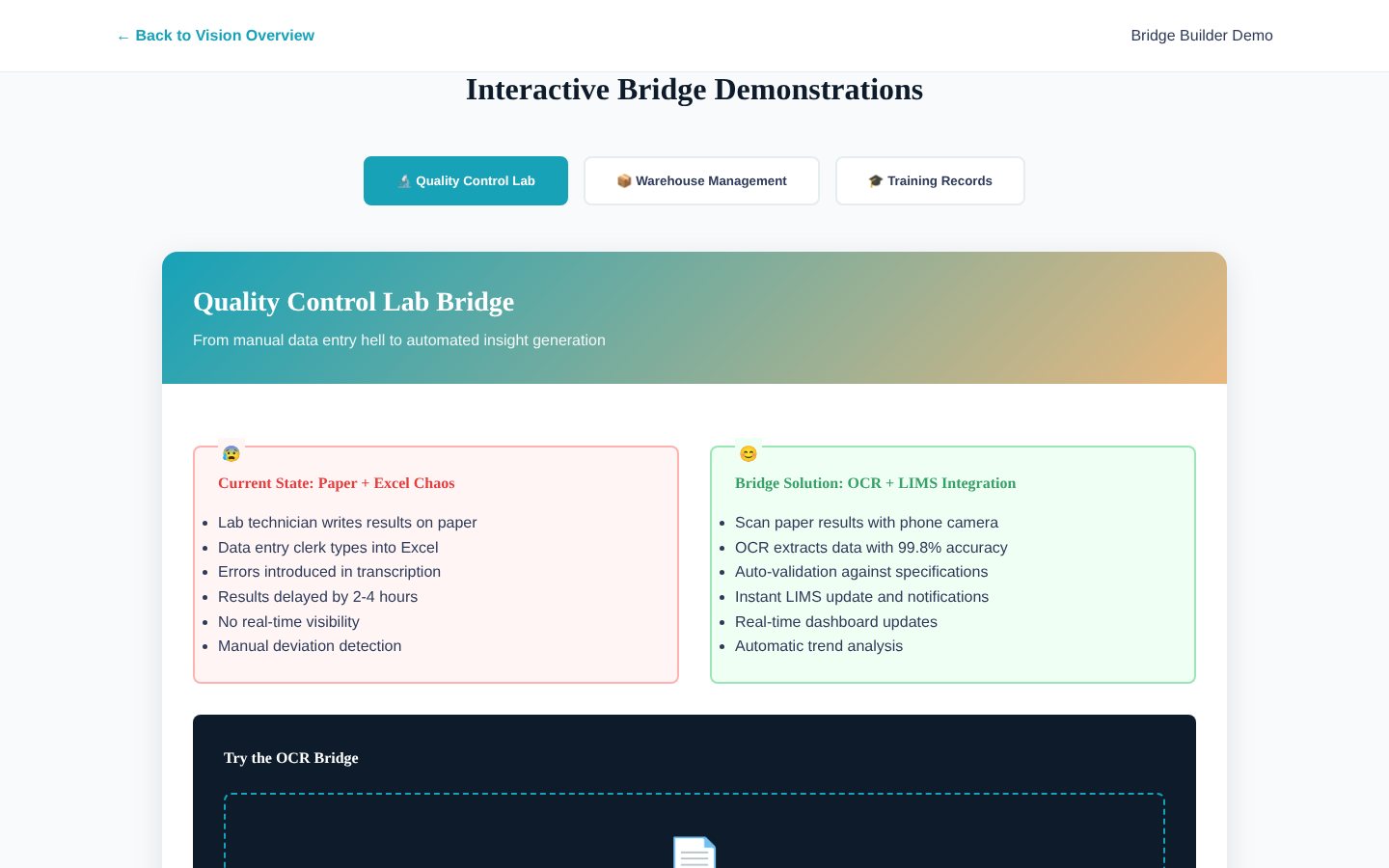
    Puts the paper process beside the proposed bridge and a scan demo
    The Quality Control Lab bridge with current state and bridge solution side by side
  4. 04 / 06

    Build an app

    You
    Drags components onto the canvas
    It answers
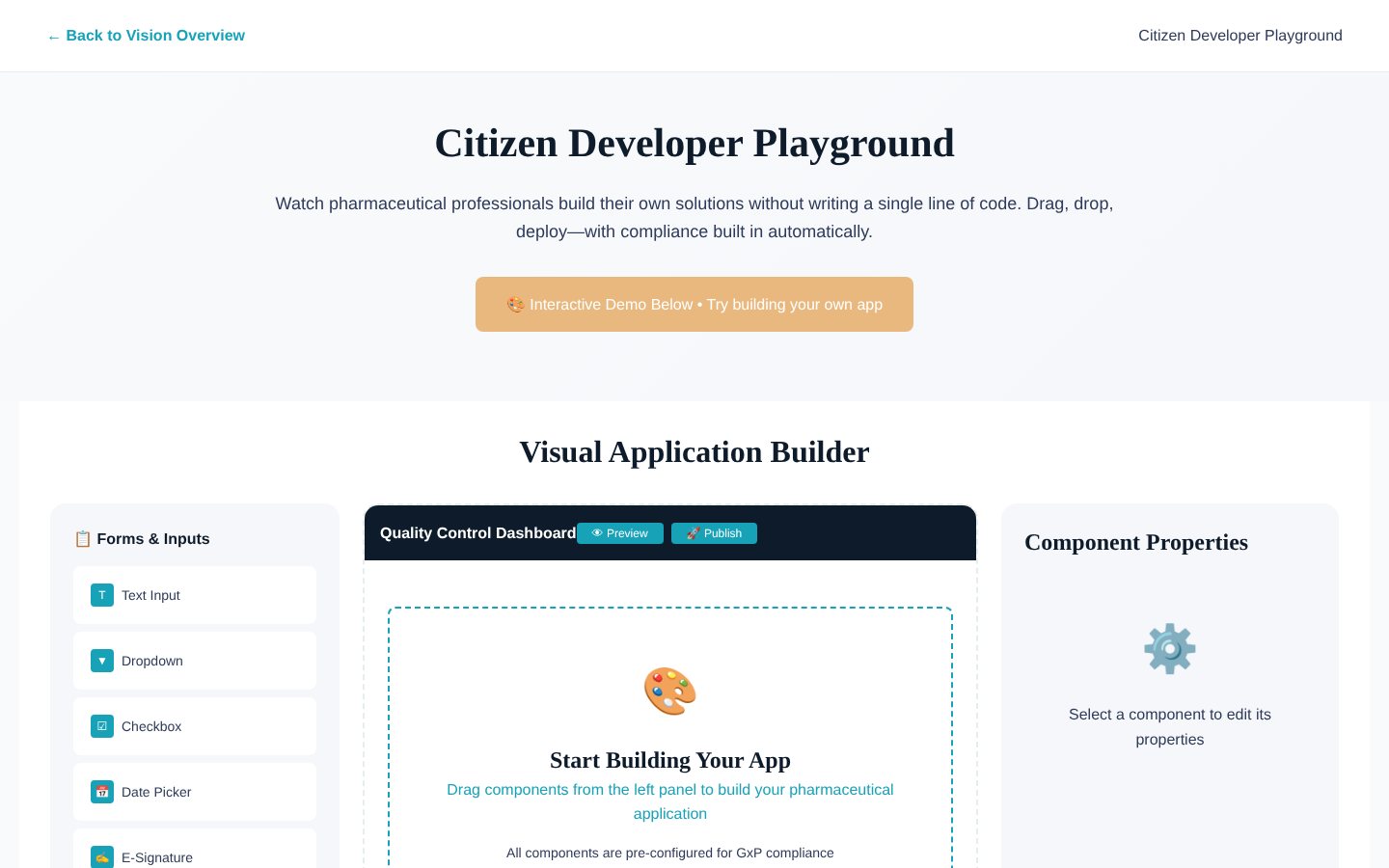
    Previews a pharma form with its compliance features pre-set
    The playground builder with a component palette and an empty canvas
  5. 05 / 06

    Pick a learning path

    You
    Chooses a role-based path
    It answers
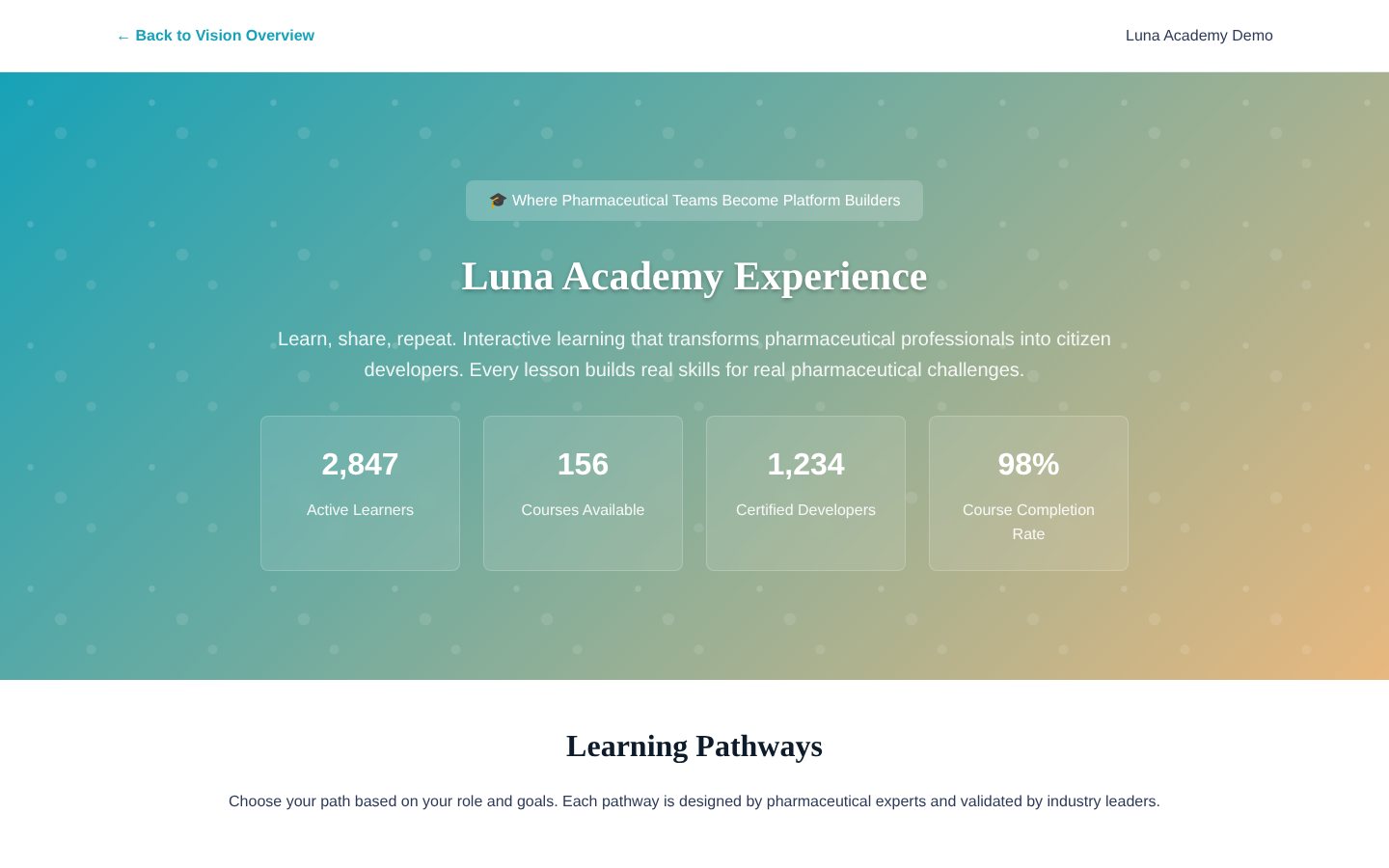
    Shows modules, progress and a certificate preview
    The academy page with four learner statistics on a gradient
  6. 06 / 06

    Read the timeline

    You
    Opens the declaration page
    It answers
    Counts down to the October 2025 event and lays out milestones to 2027

03 · What was special

What it stands on

  1. Problem first, then the bridge

    Each prototype sets a current pain beside its fix: paper and Excel beside scanning and a lab system.

  2. Self-contained pages

    Seven static pages, no build step. Each opens alone and links back to the overview.

  3. An overview that keeps time

    The overview changes colour with the time of day: dawn, day, dusk or night.

Strategy you can click through before it exists.

Making-Of

A proposal you can click.

The first commit

  1. The world before

    The transformation for Venus Remedies and Spine Software lived in reference documents: a vision, a charter, a master reference. Readers could read it, not try it.

  2. One day

    28 August 2025. The first commit carried seven prototype pages and the reference documents. A title fix and a README followed the same day.

  3. Because of that

    1. Every prototype follows one method: problem, bridge, fix (28 August).
    2. The overview adapts to dawn, day, dusk and night (28 August).
    3. The declaration page counts down to a platform event on 21 October 2025 (28 August).
  4. Until finally

    Vision Espine is launched as a set of prototypes for leadership review.

  5. Since then

    The repository holds no later commits.

The evidence Process, hands, and artifacts

Process

  1. Origin

    Seven prototype pages in the first commit

  2. Sources

    Reference documents kept beside the pages

  3. Title

    Title changed to Vision Espine

  4. Readme

    README written for the suite

Hands

Akshansh

  • Concept and the transformation narrative
  • The reference documents the prototypes follow
  • The CLEAR review standard

Agents

  • AI coding assistantBuilt the pages from his direction; the tool is not named in the repository